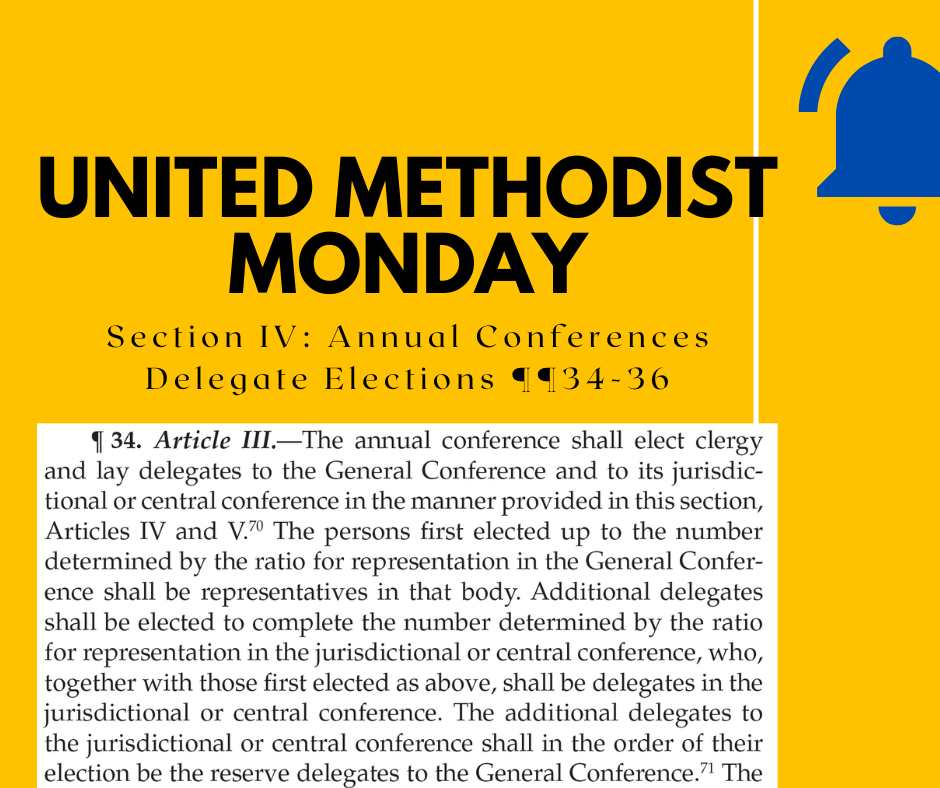
¶¶ 34-36 Outline the requirements for election of delegates to General and Jurisdictional Conference.
Essentially, annual conferences elect their representative delegates to General, Jurisdictional and Central Conference (Jurisdictional is a region inside the US, Central is a region outside the US). They elect based on a ration determined by the General Church. General Conference delegates are elected first, and then the delegates to the regional bodies. The regional body delegates serve as reserves for the General Conference in order of election.
The clergy people elected must be elders and deacons in Full Connection in that annual conference and at time of service(fully ordained by the annual conference) and they are voted on by elders and deacons in full connection, associate members (local pastors approved by annual conference for special relationship), provisional members in their residency period who have completed all education, and local pastors who have completed all of course of study or a Master’s of Divinity/educational equivalent from an approved seminary.
The laity delegates are elected from the laity within the annual conference who have been professing members in good standing for two years, and actively involved in The UMC for at least four years. The delegates must be elected (appointing or selecting of delegates is not allowed).
However, caucusing and organizing may occur to have clergy and laity elected for various reasons. Some annual conferences work hard to elect delegates of varying ethnic, gender, and sexualities. Other annual conferences work to elect folks who have particular theological/political leanings. Regardless, so long as they abide by the rules set forth in the Constitution, they can create any process of election they choose.

 Jonathan LeMaster-Smith
Leave a comment