I have received more questions and want to answer them here.
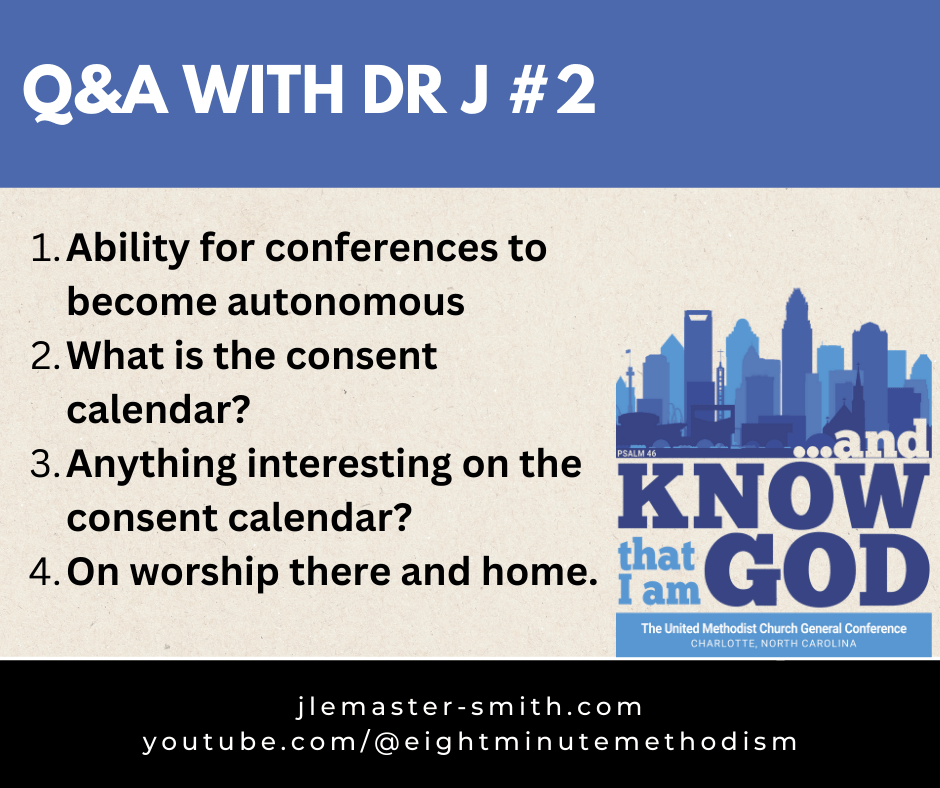
1) Will regionalization impact autonomous churches ability to leave denomination?
According to current legislation,(ADCA vol 3 – 1545), conferences that wish to disaffiliate will still have ¶ 572 to become a autonomous Methodist Churches, but the proposed ¶ 576 would also allow them to join with another Wesleyan Denomination (described in the petition).
2) What is the consent calendar?
The consent calendar is a means of passing large portions of non-controversial legislation in bundles. Legislative committees voting to add something to the consent calendar must have less than 10 votes against to add something to the calendar.
The item must not impact the budget or the Constitution. And then it is printed in The DCA, and will be voted on 24 hours after it has been in the hands of the delegates.
Someone wishing to remove an item from the consent calendar must have the signatures of 20 delegates and turn it in the appropriate people. Once the consent calendar for say, April 24th has been reviewed by the delegates, the next day, April 25th, they will vote to approve all items on the consent calendar at once.
.
3) Anything interesting on the April 24th Consent Calendar?
The only thing I find worth noting is the petition (21103-ST-NonDis-G) to create an autonomous Methodist Church in Eurasia. Passing this allows the Central Russia Annual Conference, Eastern Russia and Central Asia Provisional Annual Conference, Northwest Russia and Belarus Provisional Annual Conference, Southern Russia Provisional Annual Conference to become their own autonomous denomination separate from The UMC.
This happens regularly, and they are allowed to do this under ¶ 572. I wish them well. This has been in the works for a while, and it makes sense based on a mix of theological and cultural realities at present.
.
4) Why at General Conference (or others) do we celebrate multiple styles and expressions of praise, worship, and music, yet in our congregations we feel stuck in one mode of worship?
This is a complicated question, but my thought is that we as small communities often appreciate new things at events, but when we return home, people don’t like a lot of change, and the work to change this and do it well takes more energy than most are willing to give.
We are also often trying to replicate something that was done intentionally and beautifully for an event instead of doing the even harder and more important work of asking what worship and formation experiences do our communities actually need? .
We need ongoing conversations about the value of tradition, novelty, and incarnation. These are things that committees can’t do, and these are things you cannot change overnight.
But I encourage you, have the conversations, don’t have the expectations. Let the opportunities grow form conversations
Q and A with Dr. J #2

 Jonathan LeMaster-Smith
Leave a comment