Y’all,
It’s been a minute (life, ministry, Holy Week, the world, etc. has been a lot). But let’s talk about Methodism.
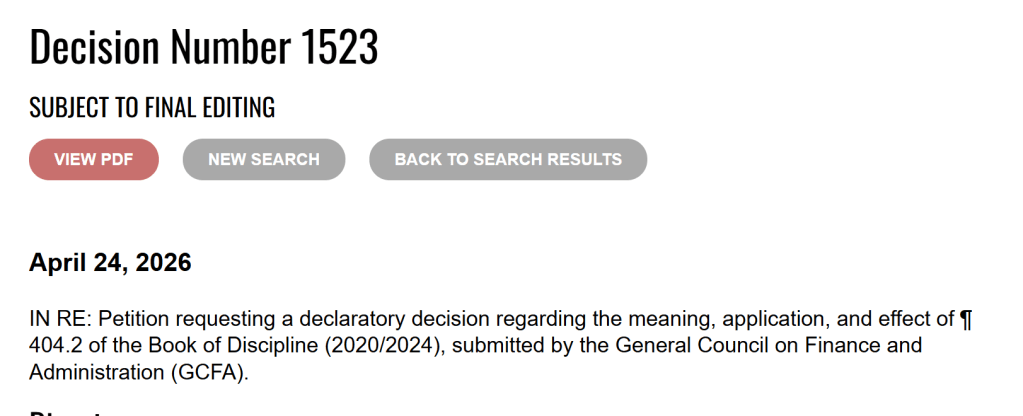
While a lot has been happening, I think the most important thing has been the recent Judicial Council Decision 1523 related to the constitutionality of ¶ 404.2.d, which reads:
“d) A jurisdiction, through its jurisdictional committee on episcopacy may request additional bishops exceeding the numbers provided in subparagraph 2.a-c) above; provided, however, that the salary and other expenses of such bishops, as calculated by the General Council on Finance and Administration, shall be apportioned to the annual conferences of such jurisdiction. Any jurisdiction seeking any bishop(s) over the base number provided in subparagraph 2.a-c) shall be able to demonstrate their ability to fund any additional bishops by providing a surety to the General Council on Finance and Administration that they are sufficiently capable to meet the full funding of additional bishop(s) for the coming quadrennium.”
The Judicial Council rules this is out of order, as it allows for Jurisdictions to procure extra bishops essentially, at its own deciding based on availability of finances and this would violate the idea of a unified episcopacy. They write in their decision:
“The Constitution does not contemplate a unified episcopacy in name only, but one that exists in fact, structure, and access across the whole Church.
The funding structure created by ¶¶ 404.2(d) and (e) violates the principle of a unified superintendency and episcopacy guaranteed in the Constitution ¶ 46, Article I, the exclusive funding authority of the General Conference ¶ 17.9, Article IV, and Judicial Council Decisions 1208, 1366, 1378, and 1499, and, therefore, is unconstitutional, null, and void. “
¶ 46 calls for a unified episcopacy which is interpreted here, to my understanding as a unified approach to selecting, funding, and assigning bishops. The new paragraphs allow for Jurisdictions to determine how many bishops they have so long as they have funding. ¶ 17.9 notes that the General Conference determines and provides for raising funds to carry out the work of the church. This new paragraph would allow for Jurisdictions to circumvent this by providing their own funding. Therefore, it is unconstitutional because of these reasons (plus some Judicial Council Decisions).
My analysis follows
Jurisdictions are a complex entities created out of racism and regionalism (this isn’t my opinion, this is stated fact). My analysis here is that this would be a way for more resource rich jurisdictions to exert undue influence on the structures and decision making of the church. I already hear complaints about smaller in population and funds jurisdictions not carrying their weight. I also hear about the need for more bishops in the more populous jurisdictions, so they aren’t covering so many annual conferences.
The reality is, here we an issue of money and power. We continue to see the United Methodist project from a colonial capitalist mindset. If we have the money, we can do what we want. But we are not a pay-to-play system. We resource communities that have needs through a mix of funding, innovation, and shared leadership. Except, we are, in many cases, pay-to-play. If a church can afford more clergy or staff, they, in general, can have them, regardless of the need. Whereas a low income area charge worshipping large numbers of people often does not get the financially supported assistance they might need (this is changing, slowly).
This is also true of appointive realities of full-time long-serving elders being appointed at places that may not fit their gifts because of salary expectations and vice versa for new clergy (local pastors or newer elders) who may be gifted in larger church ministries but start out at smaller charges. And I know the episcopacy and the appointive process are not the same, but this seems like it should say something to the realities we are experiencing. Salary and funding equalization options are available.
We are going to need to dramatically rethink the role of the bishop in the United States Regional Conference as resources restructure. We are also going to have to dramatically rethink the way we fund clergy, appoint clergy to charges, and how the connection works. The revival of the circuit and the growth of cooperative parish models (sometimes 10 or 15 churches on a circuit) is something we need.
This decision is also helpful in realizing that as The UMC grows outside the United States, but funds don’t, we need to find ways in the connection to continue to fund ministry. However, if we assume we are a pay-to-play organization, the United States may attempt (in its colonizer legacy) to control where funds go. This will remind us that numbers and power don’t determine how ministry work, the needs of the world and the work of the Spirit guide us.
Jurisdictional Council Decision


Leave a Reply