-
December 4 – “Only Love Can Save Us Now”

December 4th brings us Kesha, “Only Love Can Save Us Now.”
I am only sharing the chorus because I don’t want to get demonetized, because she swears a lot in this surprisingly theologically accurate song.
Only love can save us now
Only love can save us now
Only love can save us now
(Oh, Lord, save me, please God, I need your love now)
Only love can save us now
(Oh, Lord, save me, please God, I need your love now)
You can look up the other lyrics that call out the realities of a woman who has been to hell and back and is trying to figure out faith and hope and reality in a post reality world. This song reminds me that baptisms and faith come in many shapes and sizes, and we need to realize that sometimes we need to pray this prayer:
Yeah, Jesus take the wheel, I’m going through phases
The bitch I was, she dead, her grave desecrated. -
December 3 – “Happier”

December 3rd’s song for this year is “Happier” from Double Camp. Don’t know who Double Camp is? Neither did I when they opened for Sub-Radio. But, as they said, they sing sad songs to happy music. Which, can easily be my bag. And “Happier” is a song that hits its target.
A lyric selection:
These days are gold
Fill ’till I overflow
Grab a hold of what I know
Can make time stop
My mind explodes at all the things that I don’t know
But one thing that I know for sure
Is what I’ve got.
These words can feel like they’re spoken in another language
What life could be like if I could just understand it
I took a while to accept that I couldn’t plan it
Try to go find some answers
Turns out it’s open-ended
Oh, we’re not insane
Maybe just a little
Maybe just a little bit strange
But we couldn’t be happier
Oh, we’re not insane
Maybe just a little
Maybe just a little bit strange
But we couldn’t be happier
Honestly, it feels right. It’s a way of looking at life that reminds us that it’s okay to be happy in the midst of what’s going on. I also don’t have to defend my happiness or strangeness. -
December 2 – “Everything Will Be Alright”

December 2nd is upon us, and it’s time for the second song that has spoken to me this year. I ran across this song as the theme song to the Podcast “Delete This,” but I didn’t know it had words.
Andrew Huang’s music is a mix of ambient and electronic, and it was a good piece without knowing the words, but learning the words really hit me.
The song is “Everything Will Be Alright” and it comes from his album *Love and Desolation.* A lyric selection:
Who told you that everything will be all right?
Oh, oh you want to know it
Oh you want to dream that everything will be all right
Oh, oh everything will be all right
Carry you around in my heart
But I feel your memory go, oh
I’ll carry you around in my heart
I’ve got that heavy glow, oh
I have been listening to this song on and off all year, but with my dad’s death yesterday, it hits different. The reality is, life is still pretty good. His death is and will be hard. I don’t know that everything will be okay, but I’m willing to keep going to find out what comes next in all this. -
December 1 – “December Day”

Each day, for the month of the December, I am going to post a reflection on a song that has meant something to me this year.
First, “December Day” by Willie Nelson.
I’m working my way through Willie’s Catalog with the intent of teaching a class in rural ministry and country music next fall. It will likely be Dolly and Willie focused. “December Day” only found me a a couple weeks ago. It shows up on two of his early albums, *Good Times* and *Yesterday’s Wine.*
I heard this song while walking at the park with my dog. It hit me as a beautiful that some of our lives may active and full of meaning, but other parts are about reflecting on the beauty and the pain of life.
It’s been a pretty amazing year, and December is really a time of celebration, reflecting, and looking forward to the future. So, on December 1st, it looks like a December Day.
A lyric selection:
This looks like a December day
This looks like a “time to remember” day
And I remember the spring, such a sweet tender thing
And love’s summer college,
Where the green leaves of knowledge,
Were waiting to fall with the fall
And where September wine,
Numbed the measure of time
Through the tears of October, now November’s over,
And this looks like a December day -
The Global Methodist Church has a Constitution
The Constitution of The Global Methodist Church has been approved by their Convening General Conference today, September 24th, 2024.
My highlights:
.
It begins with a naming of its place in the church universal under the saving grace of Jesus Christ. It roots in the Methodist tradition of organizing under a common discipline.
In Article II it names the scriptures as is its central focus, followed by the historic creeds, the Articles of Religion and the Confession of Faith, and the core of the Wesleyan tradition (and then directs to the doctrine section). The UMC only lists the Articles and Confession.
One thing that is interesting is that it reverses the order of outlining bodies of the church, placing the local church/charge, not the General Conference at the core. While it is still a connectional church, it names the local church as it’s central body, not the Annual conference. The UMC names annual conference as the basic body of the church and the body that holds a great deal of control, this is one of the reasons many left, and they wanted to name the local church as core, not the annual conference.
There are only Charge Conferences, Annual Conferences, and the General Conference, no regional bodies between Annual and General.Within its Restrictive Rule it protects the Articles of Religion, Confession of Faith, Wesley’s Explanatory Notes on the New Testament, The Standard Sermons of John Wesley, and other doctrine as established by the church. It also protects the right to lay and clergy to a trial by jury in the judiciary.
Of note, The UMC protects the Articles and Confessions but not the work of Wesley. They do not protect the episcopacy or the profits of the publishing house, as we do.
Finally, until the close of 2026 General Conference, the General Conference may make amendments to the constitution with a majority vote (except the restrictive rules) and after the 2026 General Conference it then requires 2/3 vote by the General Conference and then 2/3 vote of aggregate number of delegates of the Annual Conference present and voting excluding abstentions.
This could change while they are here, but this is now their official constitution. -
Q&A With Dr J for the GMC Conference #1

Welcome to Global Methodist General Conference Q&A no. 1.
I’ll answer the questions you gave me to the best of my knowledge and ability.
1)It seems like they are voting on things really fast without discussion, are they not allowing for discussion on purpose or did they have meetings ahead of time?
If you are not part of the group having the conference, it often feels like things are moving very fast. The reality is, they had been planning this for month, and people had copies of the Transitional Book of Doctrine and Discipline, the agenda, the episcopal nominees, the Plan of Organization and Covenant. .They also have delegation meetings and online trainings for what was happening. Their transitional leadership team had been doing this work for some time and wanted to make this as smooth as possible.
That being said, even in The UMC people were voting on agenda items out of trust. Hundreds of consent calendar items were voted on in blocks. The delegates put a trust in leadership team, legislative teams, and other groups in order to smooth out the process.
2) Where did the Book of Doctrines and Discipline come from?
The Transitional Leadership team developed a book of Doctrines and Discipline based on previous Methodist and Wesleyan denominations with some new modifications for their needs. This is the Discipline they approved at the first day of General Conference. This is a barebones Discipline that they will modify and flesh out with legislation both at this conference and in the future.
3) How do their bishops work and why did they have to elect them even if they were already bishops?
They do not currently have an election process for bishop. Petition 29 must be approved by legislative committee and then by plenary. This petition will set the process for election. In this petition, bishops can serve up to two six-year terms. This petition allows for an exception in the case of Bishops Jones and Webb can stand for election in 2026 (they were elected for a two year term to continue their roles as transitional bishops). This was petition Petition 113.
Also, those elected at this General Conference will be considered interim bishops as they will only be serving a two year term. They will be able to stand for re-election in 2026 if they receive 2/3 votes. This is in Petition 114, and must still be approved for it to take effect. These persons will be elected and then consecrated.
Bishop Jones and Webb were already consecrated in a predecessor denomination so they did not require consecration, although they may be celebrated as part of this event as well.
Bishops will serve both in regional episcopal areas and in the general church (the same as UMC Bishops).
4) What is their appointment making process?
Presently, their appointment process is a consultation model in which the bishop, presiding elder, and pastor-parish committee all have voice.
If any party raises concerns in an appointment the parties have to give substantive explanation related to their concerns. The church cannot outright reject someone and the bishop cannot appoint someone without reason and explanation. But this process is appointive, it is not an open call. The bishop makes the appointment. The process is also rolling. While the annual conference receives a list of appointments at each regular session, these can change as the need arises throughout the year.
Finally, there is no guaranteed appointment. Appointment is, on paper, based solely on need and effectiveness. Moreover, if a clergyperson wishes, they may seek appointment in another annual conference. This is encouraged as well. If a bishop chooses not to appoint someone they must provide in writing their rationale.
I know some folks will note that we can rationalize anything to get past issues of race, gender, personality, or politics, but this is also true in The United Methodist Church, we just guarantee some sort of appointment that protects vulnerable populations in some cases and protects ineffective populations in others.
5) Will they bring back class meetings as a primary role of faith formation and accountability?
While they allow for small groups and there is encouragement to participate in class meetings, they do not require or emphasize this in their present Discipline or any legislation.6) What is their actual statement on Human Sexuality?
Per their social witness in their discipline, marriage is a monogamous relationship between one man and one woman. They uphold a scriptural understanding of gender and sexuality. I will not try to define that.
They do have a statement in their judicial complaint process that a clergyperson can be charged with engaging in sexuality activities outside of a loving marriage (and list some of them).
There is a petition that would change this to remove the word loving and add homosexuality to the list of activities. There are some questions here. First, sexual activity already includes homosexual activity, and two, why remove loving? But also, this makes it more biblically accurate.
All petitions related to ordination of folks within the LGTBIA+ community have been deferred to 2026. Therefore, they do not prohibit ordination of these communities in their current discipline. In fact, the phrase homosexual does not appear in their current Discipline.
7) You’re not actually blocking people are you?
Yes, I did during The UMC General Conference and I will during this one if I see the need. I am fine with disagreeing. I will not be harassed or trolled. -
Opening Worship Takeaways
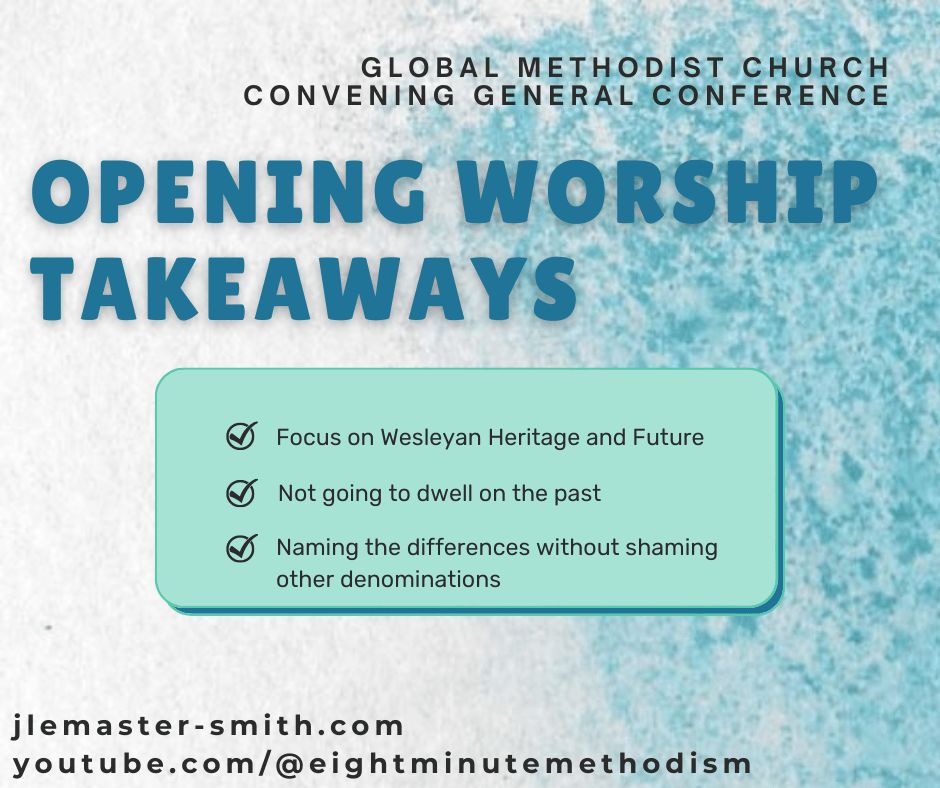
I’m such a Methodist, y’all. I teared up with the “And are we Yet Alive” and the opening gavel.
The opening episcopal address set the stage for a conference that will claim its Wesleyan heritage but not dwell on the past. They are leaning into sanctification and grace and the belief that God is doing a new thing. I think most clearly they named sanctification, especially entire sanctification as a goal, which is, honestly, refreshing. In the naming of grace, one bishop notes convincing/convicting grace. I think the addition of this grace, which Wesley uses is helpful to a denomination that is working to be more opening evangelical.
My take is that a more conservative/traditional reading of scripture is important to them, but they are working to make sure that they do not suggest or encourage it to lead to acting and speaking with hate. Invoking Wesley’s mission to reform the nation, particularly the church, and spread scriptural holiness over the land is an excellent starting point to usher in revival and renewal. Moreover, naming the reality that we as denominations need to shed some baggage is real. The UMC should listen to this too.
Finally, I think the bishops are working to make sure that The Global Methodist Church cannot be a denomination that is simply against something, they have become a denomination that is for something, and that something being the saving and sanctifying grace of Jesus Christ.
I do earnestly hope that they will be a church that spreads the gospel, lets go of the past, and works to live into the new thing God has called them toward. -
Leadership Gathering Instead of Called General Conference.

While we have heard calls, rumors, and speculation about The United Methodist Church calling a special called General Conference, the Council of Bishops has withdrawn this proposal and replaced it with something that, I feel, is more innovative. The Council of Bishops will hold a Leadership Gathering in 2026.
This gathering, according to the Press Release (LINK TO PRESS RELEASE), will have the following purpose:
1) To maintain momentum regarding implementation of the various components of the regionalization legislation. This could include developing adaptive strategies to respond to ratification results as they become known.
2) To gather hope, vision, and imagination for the future of the UMC from across the connectional landscape.
3) To initiate preparations for the 2028 General Conference by identifying programmatic, financial and structural adaptations that may need to be considered in order to maintain momentum. This should include consultation/collaboration with the Commission on General Conference regarding the design of the General Conference.
This gathering will include all active bishops (those serving Episcopal Areas), three leaders from each episcopal area, and 50 key leaders from across the connection. Bishop Tracy Smith Malone, current President of the Council of Bishops, emphasized that this should be a means of furthering momentum in our denomination as we move further into a future filled with hope.
**My Thoughts Follow**
I do think this is something like a good idea. I think it offers something that is not legislative in nature. Instead of more more voting, space to collaborate, imagine, and innovate feels right. My hesitance is that bishops often pick the same folks in leadership over and over gain, and thus diversity in terms of Methodist expressions may not be at the forefront.
My proposal is that we are a denomination that is still heavily reliant on the order of the elder, which is a shrinking order. My hope is that we take very few elders. The bishops are all already elders. My call is that we bring deacons, Local Pastors, and lay people. I also suggest it be mostly people who are under 50, who serve on very few denominational and conference leaders and board members, and who are truly new voices in the denomination.
Along with this, it should not be people from the same type of churches. So often our larger churches, suburban and affluent urban churches, and dominant conference faces are the one’s selected. Always when we elect delegates, it feels this way. Instead, perhaps we focus on smaller churches, non-white churches (in the US context at least), rural and small urban churches, and even churches who are not happy with the current state of The UMC (related to several different things).
Finally, there need to be actionable items come out of this, whether it be legislative goals, denominational intentions, or next steps in contextual and incarnational work. This cannot be a self-congratulatory and solely aspirational event that we spend millions of dollars on. We need to come together, hopefully not in the United States, to do the hard work of blending heritage and theology in our diverse contexts to create a direction toward God’s Kingdom that looks and feels fresh. As much as we celebrate the moves of 2024, some of the responses coming out of various conferences feel like we are going to quickly return to stagnation, when what we really need is God to trouble the waters.
-
No More Videos Until June

Hey Y’all,
With the end of the semester, my vacation, and my need to handle some church things, I will not have any more Eight Minute Methodism Videos until June.
I have these videos roughly scripted:
-It’s Not Over: What Comes Next After General Conference
-2020/24, explaining the what, why, and how’s of the dating system.
-Where is the United Methodist Mission in all of this?
-What matters now?
-Unboxing some old Disciplines (1700s and 1800s)
-
How the change in funding bans impacts local churches
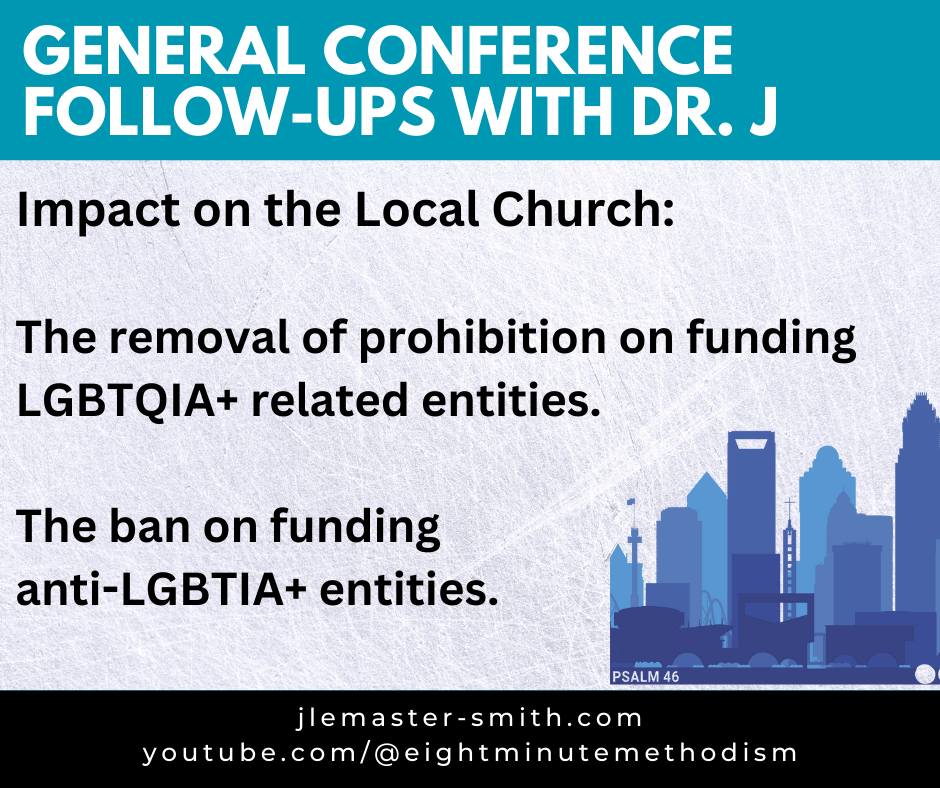
Petition 20191, which passed at General Conference, deletes all prohibitions for annual, jurisdictional, central, or General conference board, agency, committee, commission, or council giving to pro LGBTQIA+ organizations. It replaces it with a prohibition on giving to anti-LGBTQIA+ entities for these same entities.
A couple questions came my way.
Question 1: I am a conservative, and do not want my church’s apportionment dollars going to pro-LGBTQIA+ entities, what is my recourse?
To that, I have two responses:
One, make sure you know what entities you are talking about, because some of these are suicide and self-harm prevention agencies, entities that support historical research (GCAH just launched a new center), entities that promote discipleship resources, etc.
.
I doubt you are opposed to suicide prevention, faith formation, and historical research. Likely few of these entities are giving to organizations that are solely queer in their direction.
Two, the recourse you have is to vote at Annual Conference. Most of your apportionments stay in your local annual conference, and are used by local conference entities.
Pay attention to budgets, grants, and funding. Figure out how funds are distributed. Learn who is on what board or agency. Do the political work.
Question 2: How does this impact the local church and indvidual United Methodists? Can churches still order chick-fila for their meals? Can they still shop at Hobby Lobby for craft supplies? Do I as a United Methodist need to re-evaluate my purchases?Short answer, this does not impact local churches and individual United Methodists.
Longer answer, it can impact local churches and individual United Methodists if they choose to engage it. The denomination generally cannot tell the local church how it spends its money (unless it’s doing actual nefarious work). It also cannot control what we as individuals do with our own money (although accountability is nice). However, personal conviction and congregational conviction matters. Local churches can set boycotts and restrictions on their funds (they already do). The Book of Resolutions (2012, I believe) has the process for initiating a boycott in the local church or local church entity. These boycotts happen at the Charge Conference.Local boards can also decide where their donations go, preferred vendors based on their values (I know many churches who shop at places that honor veterans or who care for the hungry in the community). Therefore, if you are lay or clergy and convicted, talk with your local church about steps you can take. Many of them don’t realize the power of their spending both individually or as a church.
If you are committing to queer inclusion and advocacy, do the research and act. If you are committing to another justice issue, do the research and act.
Conviction leads to action.
-
Subscribe
Subscribed
Already have a WordPress.com account? Log in now.
 Jonathan LeMaster-Smith