-
Deacons and Sacraments: A Matter of Authority

Deacons in The United Methodist Church have now been given authority to preside over sacraments (Holy Communion and Baptism) and Charge Conference (the annual meeting of the leadership of the charge) beginning January 1, 2025 (or before, if their bishop chooses to grant it earlier).
I have received a few questions and comments on this.
The first was, “We have Deacons?!”
Yes, we have had Deacons as a separate order since 1996. My wife is an ordained Deacon in our annual conference. Before that, clergy were ordained deacon and then after this provisional period and board of ordained ministry approval, ordained elder. We no longer have a transitional deacon (as some more liturgical traditions have). Our deacons are ordained and connected in the same way as elders in our denomination. By meeting the educational requirements, being approved by board, and being elected to the Order of the Deacon by the annual conference ordained clergy meeting in executive session.
Deacons are called to ministry of Word, Service, Compassion, and Justice in order to bridge the gap between the church and the world. They are appointed to specialized ministries both within and outside the church, but are expected to be actively involved in both the ministries of the church and the world. I know deacons who run radio stations, serve as youth and children’s ministers, serve as social workers, run mission agencies, and, on occasion pastor churches and communities seeking to be actively involved in mission.
Second, “They can’t perform sacraments?”
Deacons have not been allowed to perform the sacraments (without special permission) or preside over the formal business of the local charge for a few reasons. We believe that the work of the sacraments and the business of the church are tied to the life of the congregation, and thus should only be done in communal context. Deacons are always serving in a local congregation, but every local congregation should have an elder, local pastor, or other clergy person (usually) appointed to preside over sacraments.
However, some deacons who are appointed to serve in situations outside the church may have a need for sacramental authority. I think of this particularly in terms of campus ministry, chaplaincy, and emerging worship spaces. No, a Deacon who is a lawyer is probably not going to be baptizing, nor should they in that context.
Because, we understand sacraments to be tied to the life of the church. Baptisms should always be baptisms into the local church (this is another whole thing that I am eventually going to do something with). We don’t willy-nilly baptize people. Communion is not to be done in isolation. Private communion is not a thing we do (again, another thing we need to talk about). We need to remember our theology and polity around these practices.
Third, “Why do they want sacramental authority?”
I know many deacons who did not want sacramental rights and will likely use them very little. They are also afraid of the reality that there is a clergy shortage and they might get asked, forced, or guilted to serve a church as pastor-in-charge full or part-time. (There is concern about the domestication of the Deacon into the church) Those that do want sacramental authority want of course include ministry context, but also name it as an issue of respect and authority.
Deacons (who have ordination requirements that are essentially the same as an Elder) are continually treated as less important than elders even though they are co-equal orders with distinct callings. This move cracks more of this barrier.
In the end, I trust Deacons to make decisions about their calling in ministry, when the sacraments make sense for them, and when they don’t. Some deacons are not called to sacraments, others see them as part of their specialized ministry, but all deserve respect and acknowledgement of their ministry and vocation. I also call on Elders to be respectful and responsive to the ministry of the Deacon.
I think this move (like all General Conference actions) is not an ending of a journey, but a continuing exploration of how we understand the church, clergy, sacraments, and God’s Kingdom.
-
The Sunday After…

Below are my thoughts on speaking into the anxieties and hopes that come next.
You did not choose me, but I chose you. And I appointed you to go and bear fruit, fruit that will last, so that the Father will give you whatever you ask him in my name. – John 15:16
With General Conference over, we as pastors, teachers, and other ministers in The United Methodist Church are now charged with interpreting what has happened, what it means for us, and what it means for the future of the church. One reality that we face is, we cannot predict the future, we have no crystal ball to see how the changes to The Book of Discipline, and more so, the life of our denomination, will play out.
But I am hopeful. And my encouragement with every pastor, educator, and faithful United Methodist is to be honest about what happened and is happening. Name that we have begun a process of regionalizing for contextual ministry and connectional power. Name that we have revised our Social Principles to be more global and scope and grounded in history in tradition. Name that we removed restrictive language around human sexuality, ordination of LGBTQIA+ folks, and the hosting of queer weddings. Acknowledge that we now have two definitions of marriage.
Then, beyond the big-ticket items, explore with them what it means that we have begun the process of revising our language around race, gender, and disabilities. Name that we opened sacraments up to the Order of the Deacons. Explain that we have removed paths for disaffiliation and disconnecting, and that we have begun the process for letting other churches back into the denomination. But for those who are different, we have reaffirmed that we are allowed to disagree, and that the church acknowledges that, and we even name the language in the Book of Discipline.But beyond the facts, I want you to also acknowledge that you cannot predict the future of how this will impact your church or any other church. Acknowledge your own anxieties, because we all have them. But also, acknowledge your hopes, because we all have them. I know that I will be focusing on the beginning of the dismantling of top-down leadership, including instructing boards and agencies to create contextual resources, of affirming churches’ and pastors’ rights around worship, mission, and ministry in context. That my churches are both parts of the greater denomination, and beyond that the family of God. But I will also note that we have doubled down on the reality of contextuality of ministry, belief, and action. They each have their own personalities, perspectives, and passions. And, that it is those very things that will help us be the church God is calling us to be.
You’re going to have people with all sorts of emotions, but instead of bracing for impact, why not be open to letting people express their feelings and concerns, and walk with them through those feelings. Now, this does not mean acquiesce to bullies ramped up by needs of fear and control. It also does not mean to be a doormat by letting them walk all over your name and the name of The United Methodist Church. Because, what I also saw is a church that is no longer tolerating people who refuse to work together to create a future that looks toward God’s Kingdom, even amid our differences.
I am praying for you and for your churches as we discern.
Onward to Perfection Y’all,
Dr J -
Judicial Council Decision 1499
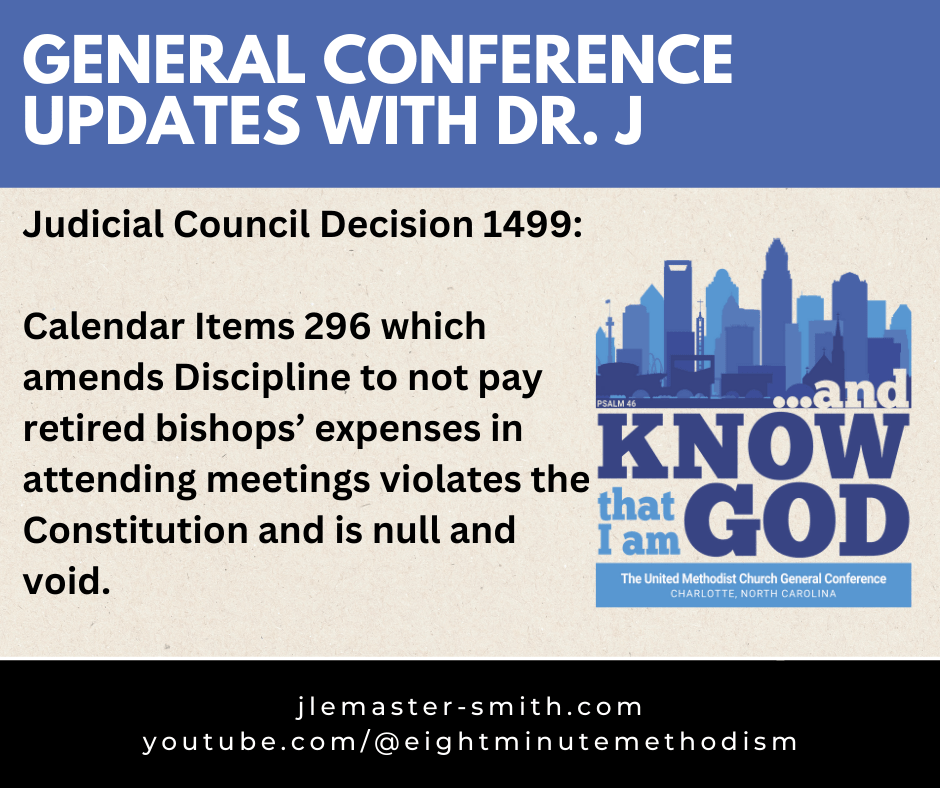
Judicial Council Decision 1499 is related to Calendar Item 296 which amends ¶409 to state “A retired bishop is a bishop of the church in every respect and continues to function as a member of the Council of Bishops at their own expense in accordance with the Constitution and other provisions of the Discipline.” (the addition is italicized)
The Judicial Council rules that this amendment to the Discipline violates ¶47, which states that all bishops (including both active and retired bishops) are authorized to be part of the Council of Bishops. And their expenses should be paid.
And, thus, as the decision reads: Petition 20299 (Calendar Item 296) as amended violates ¶ 47 and is unconstitutional, null, and void.
-
Judicial Council Decisions 1498

Judicial Council Decision 1498 lets us know Bishops retirement age is not attached to elder retirement age. Bishop’s mandatory retirement age (At the time of the request and decision) was 68, elder retirement age is 72.
Bishop’s must follow a retirement age, if it set for them.
Thus, form the decision: A bishop in a central conference shall be retired at a date no later than one year following the adjournment of General Conference, if the bishop’s sixty-eighth birthday is reached on or before the opening day of his or her scheduled conference effective on January 1, 2016.
***NOTE: We later passed Calendar item 408 which moves the mandatory retirement age of bishops to 72, but this does not render the item moot, as elder retirement age and bishop retirement age could change.***
-
Sacramental Authority for Deacons
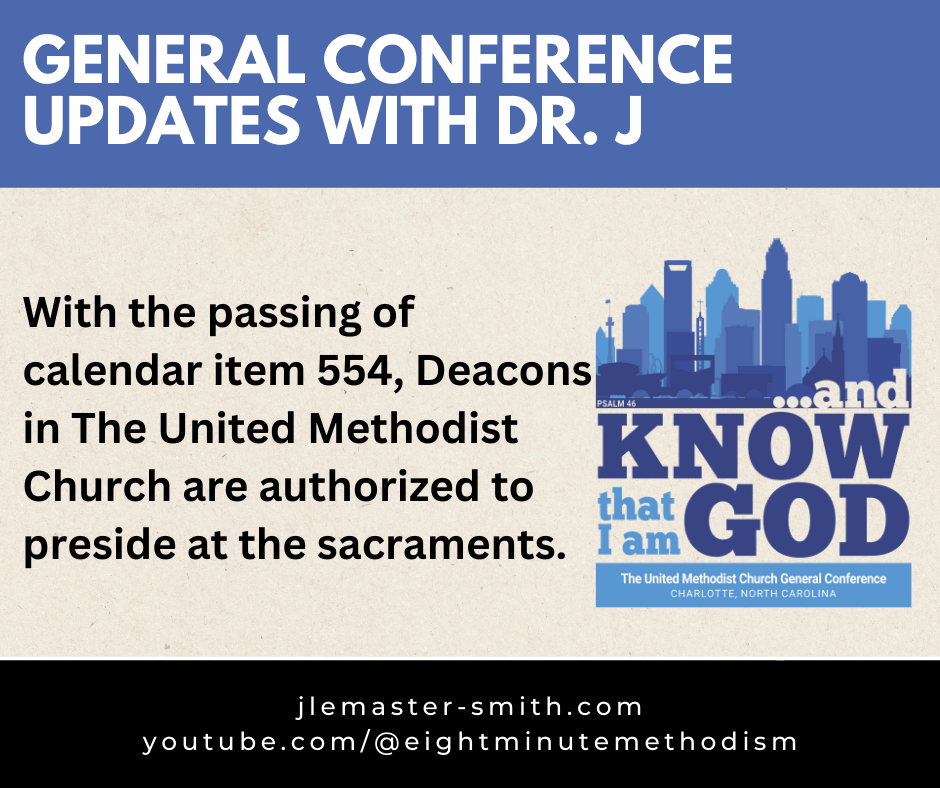
With the passing of calendar item 554, Deacons in The United Methodist Church are granted sacramental authority. The phrase: “the deacon is authorized to preside at the celebration of the sacraments” is what does it.
I know many deacons have longed for this day as they seek to more fully live into their vocation. It also provides a level of authority and respect to deacons, as many looked down up deacons as not equal to elders, and this is one of the reasons. It also reminds bishops who may not be friendly to the order of the deacon, that they are clergy and on equal footing with elders.
Not all deacons will have a need or desire to preside because of their ministry setting, but for those who feel it is necessary for their setting it is a relief.
-
Social Principles with “Double Barrel” Definition of Marriage

With the passing of Calendar Item 535, we have completed our work on revising The Social Principles to be more reflective of our global denomination and more rooted in historical and biblical tradition.
This item includes the revision of the definition of marriage and human sexuality. We now have two different definitions of marriage to be interpreted in context. The new ¶161.D. reads: Within the church, we affirm marriage as a sacred lifelong covenant that brings two people of faith, an adult man and woman of consenting age or two adult persons of consenting age into union with one another…
This “double barreled” definition was brought forth by a non-US delegate to create a space for people with differing beliefs and different local and federal laws. Therefore, we now allow for different expressions of marriage for the diverse contexts in which we all live.
Again, no one is forcing a pastor to perform a marriage they do not want to perform, no one is forcing a church to hold a wedding it does not agree with, and no one is forcing you to agree with either definition (as this is not church law).
This feels right because because of our global nature, our willingness to be creative and connecting.
-
No More Disaffiliations
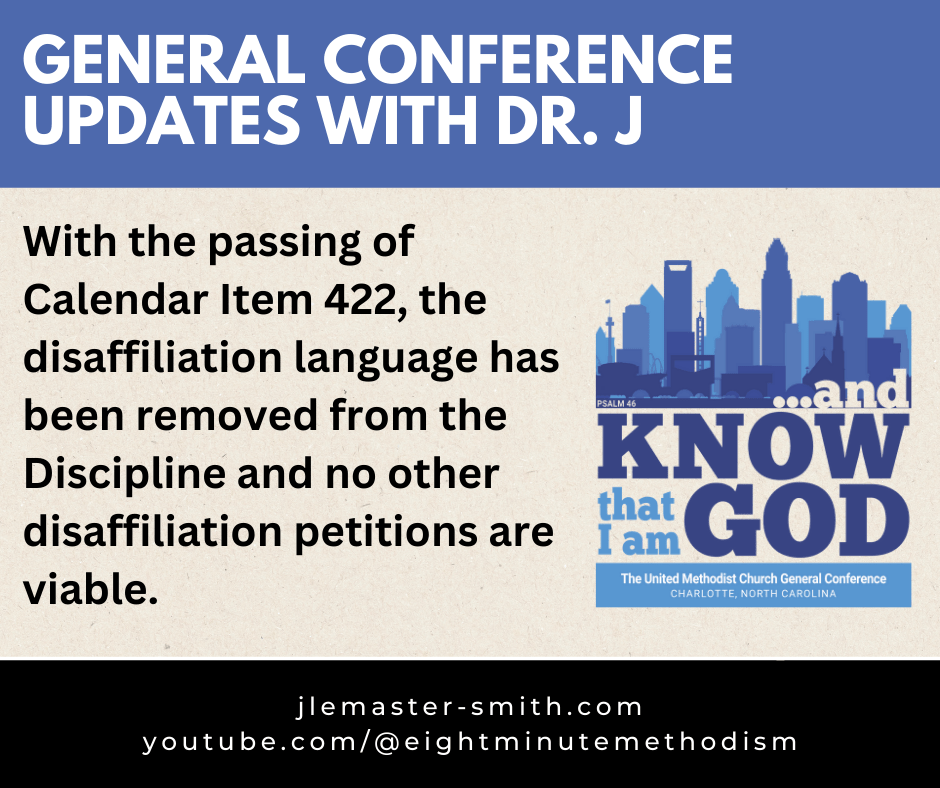
With the passing of Calendar Item 422, the *already expired* disaffiliation related ¶ 2553 has been removed from The Book of Discipline.
And, as far as I can tell, no petitions related to alternate disaffiliation process are viable.
Therefore, we no longer have a way for a local church to leave The United Methodist Church.
-
Queer Folks no longer banned from Ministry

With the passing of the Consent Calendar (A05), we have deleted paragraph ¶ 304.3
This includes the phrase: “Homosexuality is incompatible with Christian teaching” and the ban on queer folks being candidates, licensed, commissioned, or ordained in ministry. -
Changing Number and Purpose of Bishops

With the passing of Calendar Item 547 we have changed the formula and rationale for the number of bishops we elect in The United States (and elsewhere, but the US is the focus of the post).
It used to be that The Jurisdictions received bishops based on numbers and land area. We determined that this was no longer a helpful metric.
Therefore, we decided that each of the five jurisdictions would receive five bishops each. If a jurisdiction wants more bishops, they can request them, but the jurisdiction, not General Church, will have to pay for them.
This goes to my suggestion that we are fading out bishops, slowly.
But, one thing that we note here, is that we are giving a different reason for electing additional bishops. It is no longer based on population and land area, but on missional needs and priorities.
We will begin to elect bishops beyond the minimum because we have a missional and formational need in our regions. We get to use context to determine our needs, not “we need to fill a space.”
I am fine with several conferences sharing bishops. I am fine with merging conferences when it make sense. But, I am overjoyed with the idea that we can now add bishops based on our missional needs and hopes for the future of the church. -
Polity Pop-Up Minority Report
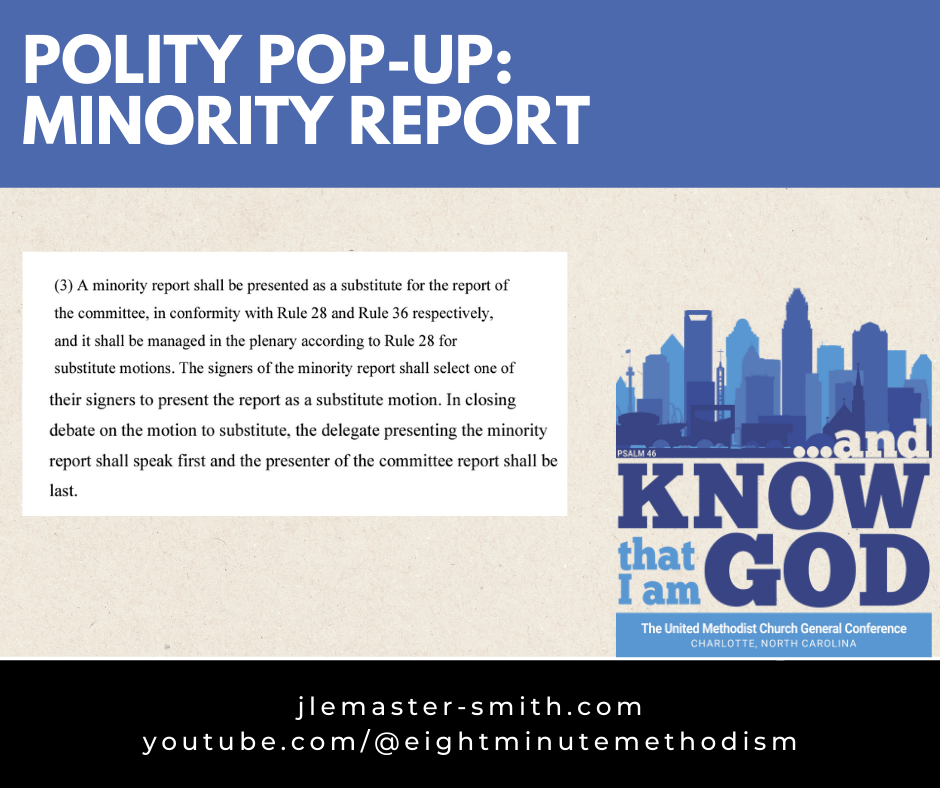
What is a minority report?
A minority report is when a committee votes one petition and there is a large enough portion of a minority to present a substitution to this.
In the first 2020 General Conference Minority Report, the financial Administration committee voted to amend a petition to increase the apportionments to annual conferences that would cover the cost of the General boards and Agencies.
A minority report came forward to substitute this amended petition with the original petition. This comes as a substitution, and we must first discuss whether we want to allow the minority report to become the main motion and delete the main petition (the amended amount). Minority reports allow people who disagree passionately with the main legislation to attempt to overturn it in the plenary.
In this case, the minority report prevailed, but we then have to do debate and vote on this.
-
Subscribe
Subscribed
Already have a WordPress.com account? Log in now.
 Jonathan LeMaster-Smith