-
Several Pieces LGBTQIA+ Legislation Pass
With the passing of the Consent Calendar today (April 30th), several LGBTQIA+ petitions passed.
Petition 20191 – Paragraph 806.9, GCFA Responsibility, strikes the language banning UMC funds from going to LGTBQ causes and replaces it with making sure that UMC fund don’t go towards causes that reject LGTBQIA+. This provision takes effect immediately upon General Conference adjournment.
Petition 20176 – Paragraph 304.5, Qualifications for Ordination, strikes the language added by the Traditional Plan barring district committees on ordained ministry and conference boards of ordained ministry from recommending clergy candidates that don’t meet the requirements in Paragraph 304.1-3.Petition 20304 – Paragraph 415.6 strikes language prohibiting bishops from consecrating “self-avowed and practicing homosexuals” and requiring annual conference boards of ordained to examine candidates regarding their sexuality.
Petition 20709 – Paragraph 425, Local Discernment of Clergy Candidates, adds an option for elders who are LGTBQ+ to be appointed across annual conferences lines, when they cannot be guaranteed a safe appointment in their home conferences.
Petition 20387 – Paragraph 2711.3, Next Generation UMC #22 – Penalties, strikes language requiring specific minimum punishments for performing same-gender weddings.
Petition 20363 – Paragraph 2701, Building a Fully Inclusive Church, adds “persons with disabilities, economic conditions” to the list of items that should receive special attention regarding judicial proceedings.
Petitions 20360 and 20368 – Paragraphs 2701 and 2702, Moratorium on Judicial Proceedings, sets up a moratorium on all judicial proceedings concerning human sexuality by adding a new subparagraph to 2701 and adding references to 2702. These provisions go into effect immediately upon adjournment. -
Report of the Credentialling Committee
The Report (Which my hero David Livingston requested) from the Credentialling Committee related to why so many African Delegates were not present.
My notes:
+Some Central Conference Annual Conferences did not provide correct contacts for conference secretaries (or had multiple names)
+Some Central Conference Annual Conferences elected incorrect numbers of delegates as assigned by the General Commission.
+Some Central Conference Annual Conferences had fake certificates of invitation to General Conference
+Some Central Conference Annual Conferences provide an incorrect number of categories as part of their delegate list with repeats of people on various lists.
+Some Central Conference Annual Conference Delegates did not secure visas
+Some Central Conference Annual Conference Delegates are dealing with personal crises.
+Some Central Conference Annual Conference Delegates are just not responding/have had no communication.
My opinion follows:
What I am understanding here is that the General Commission in the General Conference mostly did its due diligence, but due to some bad record keeping, confusion around numbers, and potential bad actors, things happened.
What is wild though is that this was a 5 year process, and the General Commission had a huge undertaking, but it feels like more could have been done to connect, correct, and update. Much of this General Conference feels so last minute and thrown together. That could include the Council of Bishops, the Standing Committee, the Connectional Table, or other groups. But, I don’t know all the ends and outs. I feel like there truly was a good faith effort, but in our efforts to be more global, we might be more diligent and supportive in the future.
Also, hopefully, any bad actors will be held accountable.
-
Judicial Council Decision 1497
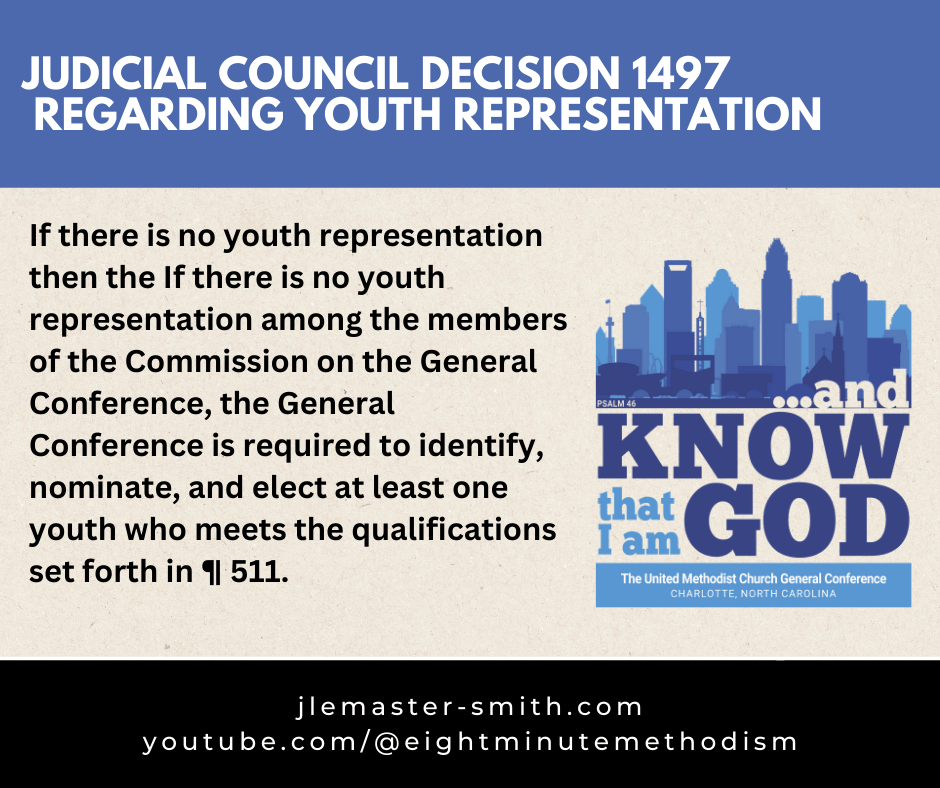
Judicial Council Decision 1497 – RE Youth Representation on General Commission on General Conference
From the Decision:
If there is no youth representation then the General Conference is required to identify, nominate, and elect one youth.
While ¶ 511.1.b) says nominees to the General Commission on General Conference must be seated delegates, it appears ¶ 511.1.a) supersedes this. It states: The voting members of the commission shall be elected quadrennially by the General Conference and shall consist of twenty-five members as follows: one person from each US jurisdiction, one person from each of the seven central conferences, one young adult, one youth.
And thus the Judicial Council notes: The Discipline requires youth representation on the Commission under ¶ 511.1a. The General Conference is required to find, nominate, and elect at least one youth to the Commission.
Therefore a youth nominee must be brought forward. (I hear they are working on it). -
Pop-Up Polity Lesson: Bishop Elections and Assignments
It seems that we need a reminder on what different conferences do related to bishops and annual conference borders. (Scroll down to the word BASICALLY if you this is long).
Under the responsibilities of General Conference:
¶16.10. To fix a uniform basis upon which bishops shall be elected
by the jurisdictional conferences and to determine the number of
bishops that may be elected by central conferences.
¶16.12. To change the number and the boundaries of jurisdictional
conferences upon the consent of a majority of the annual
conferences in each jurisdictional conference involved.These are the only responsibilities of the of the General Conference related to Bishops and Central Conferences.
The General Conference is allowed to determine:
-how many bishops the Central Conferences are allowed to elect.
-how the jurisdictions get to elect bishops (they determine how many they elect).
-the determine the boundaries of the Jurisdictional conferences.
They do not determine the boundaries of annual of the annual conferences or how the bishops are assigned within their Central and Jurisdictional Conferences.
Under the Responsibilities of Jurisdictional Conferences:
¶ 27.2. To elect bishops and to cooperate in carrying out such plans for their support as may be determined by the General Conference.
¶ 27.4. To determine the boundaries of their annual conferences,
provided that there shall be no annual conference with a membership of fewer than fifty clergy in full connection, except by the consent of the General Conference.
Also, in ¶ 524.3.b)[The Jurisdictional Committee on the Episcopacy shall]Recommend boundaries of the episcopal areas and the assignments of the bishops.
and ¶ 524.3.d) [The Jurisdictional Committee on the Episcopacy shall] Determine the number of effective bishops eligible for
assignment.
The Jurisidictional Conferences determine the number of bishops, the boundaries, names, and number of annual conferences they have.
Under the Responsibilities of the Central Conferences:
¶31.2. To elect the bishops for the respective central conferences in number as may be determined from time to time, upon a basis fixed by the General Conference, and to cooperate in carrying out such plans for the support of their bishops as may be determined by the General Conference.
and also,
¶ 543.3 When a central conference shall have been authorized to elect bishops, such elections shall be conducted under the same general procedure as prevails in the jurisdictional conferences for the election of bishops. A central conference shall have power to fix the tenure of bishops elected by the said central conference.
¶ 543.8. A central conference shall fix the boundaries of the annual conferences, provisional annual conferences, missionary conferences, and missions within its bounds, proposals for changes first having been submitted to the annual conferences concerned as prescribed in the Discipline of The United Methodist Church.They get to assign their bishops, they get to determine boundaries of the annual conferences, and create but the General Conference sets the numbers of bishops.
BASICALLY:
General Conference determines how the Jurisidictional Conferences elect bishops but not how many elect or how they are assigned.General Conference can determines how many bishops the Central Conferences can elect, and they elect in essentially the same way as the Jurisidictional Conferences.
Central and Jurisdictional Conferences determine their own annual conference names, boundaries, and how bishops are assigned.
-
Request for a Declaratory Decision from The Judicial Council Regarding ¶ 511.1.a-b

Our first request for a declaratory decision to be sent to the Judicial Council!!!
Ian Carlos Urriola has requested a declaratory decision on whether the General Conference is violating ¶ 511.1.a-b.
This is a request to determine since no youth are seated at General Conference, and the nominations for the General Commission on the General Conference must come from delegates and be delegates seated at the current General Conference, are we violating the Book of Discipline?
The General Conference is not required to have youth delegates. Neither the Constitution nor the General Conference Section ¶ 501-511 mandate it.
The Judicial Council has reminded us that this is the 2020 General Conference, so they may rule that they were youth when elected. But it also feels like judicial gymnastics to do this.
I don’t know what this means if we are found in violation? I would assume ¶ 511.1.a-b may be ruled out of order, not the entire General Conference.
-
Dr J’s Song of the Day for April 29th

Dr J’s Song of the Day for April 29th is “RIOT” by “The Scarlet Opera”
A lyric selection:
Ooh, I kinda like it, gets me excited
The sound of giants, we can’t keep this quiet
Ooh, I kinda like it, gets me excited
Let’s start a riot, we could start a riot (hey)
Say what you want
There’s a great big world and a billion of us
So say what you love
If it’s money you need and your pockets are shut
Then run to the club
I’m buying a round, oh, the queens are in town tonight
So dress to the nines
It’s time to get it going y’all.
Time to celebrate the best and worst of The United Methodist Church.
Time make decisions that usher in the Kingdom of God.
Let’s Go!!!! -
Dr J’s Song of the Day April 28th

It’s the Sunday of General Conference, and Dr. J’s Song of the Day is “The Middle” by Zedd, Maren Morris, and Grey.
A lyric selection:
Take a seat
Right over there, sat on the stairs
Stay or leave
The cabinets are bare, and I’m unaware
Of just how we got into this mess, got so aggressive
I know we meant all good intentions
So pull me closer
Why don’t you pull me close?
Why don’t you come on over?
I can’t just let you go
Oh baby, why don’t you just meet me in the middle?
I’m losing my mind just a little
So why don’t you just meet me in the middle?
In the middle
Baby, why don’t you just meet me in the middle?
I’m losing my mind just a little
So why don’t you just meet me in the middle?
In the middle
We’re in the middle. The legislative committees have adjourned. Now we wait.
We reflect on where we’ve been, the messy realities of life, and as we await the plenary sessions, maybe, like the song says, we’re losing our minds, just a little.
We’ve all got good intentions, I hope, but the reality is it’s going to be messy no matter which way we go. -
Q&A with Dr. J #4

Questions will be answered to the best of my ability.
1. Have any petitions related to Deacons sacramental authority and leadership authority made it out of committee?
So far, calendar items related to Deacons include:
-rewording the authority of provisional Deacons to include the phrase, “The appointment setting is defined as ‘people within or related to the community or ministry setting being served.”’ to better clarify the role of the Deacon.
-naming alternate routes for deacons related to professional certifications and full time service.
-sacramental rights for deacons has made it out committee in the form of petition 20897.
-deacons are now included in the list of pastors in ¶339.
-deacons are included in those who can preside at Charge Conferences.
-petitions to make Deacons eligible for bishop and district superintendent do not make it out committee.
-other deacon related work is clarifying the appointment of the deacon (just better wording for local church, extension, other denominations, and school) and that the their are resources for exploring the appropriateness of appointments.
2. What happened with the Local Pastor related petitions?
Most local pastor related petitions were bundled and “not supported” by the committee, and there has been a call for a ministry study. This is disheartening for many, as local pastors often feel like the leftovers and placeholders. Also, many churches feel like their pastors are not supported in the system as well. I would encourage those local pastors who feel disempowered to begin the work of conversations with clergy and laity in their conferences, AND to organize within their local Fellowship of Local Pastors and Associate Members.
Some things that did pass: Retired local pastors may continue serving so long as they have completed educational requirements or are willing to complete educational requirements. And, as long as they are under appointment, shall attend annual conference with voice and vote for those things allowed for the local pastor.
Also, local pastors can now more easily serve in conferences other than that in which they were certified as candidates.
3. Any idea when the legislation on removal of language and the other LGBTQIA+ concerns?
-Many petitions passed committee that add sexual orientation and/or gender identity to the expectations of leadership and committee roles on various levels of the church.
-A petitions that remove restrictions on same sex weddings by pastors and in our churches have made it (by close margin) to the plenary.
-A petition that place moratoriums on any human sexuality related complaints passed committee.
-A petition that removes not only being a “self-avowed practicing homosexual” and conducting same sex weddings, but also requirements for celibacy and singleness/faithfulness in marriage as chargeable offenses.
-The revised Social Principles that made it out committee include piece that remove incompatibility language and redefine marriage as between two people.
-I cannot tell you the days all of these will make it, but pay attention the calendar items in the DCA.4. Who selects which bishops will preside over the plenaries? Will my bishop preside?
¶ 16.11 notes that the General Conference selects all presiding officers (except the first one, the council of bishops selects the first presider). We delegate this power to the committee on presiding officers as part of the Commission on the General Conference.
5. Will there be any more disaffiliations?
It appears that all disaffiliation and exit plans have been rejected.
But there is a petition for churches to return who have disaffiliated.
6. What is something boring that has passed that is actually a significant deal?
In consent calendar for April 27th, which we will vote on in the plenary on April 29th, the role of Discipleship ministries has the phrase “Develop standards” replaced with “Promote contextual” in the phrase: Promote contextual resources for the conduct of public worship in the churches, including liturgy, preaching, the sacraments, music, and related arts.
This means the Board of Discipleship/Discipleship Ministries is no longer tasked creating standards but providing multiple contextual resources for worship in various settings, locations, and venues.
7. What is something that seems significant that is actually boring?
Russia and the Eurasian Countries leaving. This happens regularly. -
What about Sunday?
I wait for the Lord; my soul waits,
and in his word I hope;
my soul waits for the Lord
more than those who watch for the morning,
more than those who watch for the morning.-Psalm 130:5-6
A few people had messaged me wondering what to say in their churches in the Sunday in between. Five days of General Conference have passed and five more are on their way. We are already tired, and we have long way to go before we rest.
But, we get a Sunday. Sunday, the sabbath for most Christians, is not a day of rest as much as it is a day of hope, a day of anticipation. The sabbath is the day we work to experience and imagine God’s Kingdom. We celebrate the resurrection and new life in Christ, we partake in sacrament and ritual, and we fellowship with the family of God.
We have the opportunity each and every Sunday to imagine and experience God’s Kingdom again, hope for that Kingdom, and as it comes to a close, prepare to begin building the Kingdom God calls us toward. And that is what I plan to do.What I saw with the last five days of General Conference is one of determined hope. Opening worship began with songs that both grounded us in Christ and our Wesleyan tradition and called for us to expect and anticipate a revival that is coming. Bishop Bickerton had stern words for those who would wish to sow discord among the people called Methodists. In fact, some people could not seem to handle my interpretation of his words, which called on people who wished to sow discord if they did not get their way to GET OUT and let us do our work.
The other Bishops have added to the message to call out evil, to trust in the power of God, and to be the church God needs us to be so that we can keep building God’s Kingdom. We are a church that is done with nonsense, lying, and evil, and we have a tenacious hope that is not going to be stopped by the wickedness that would seek to divide the church.
In terms of legislation we see the foundation being laid for, as our doctrinal standards say, a church that is both practical and incarnational. The passing of legislation around regionalization begins the process of contextualizing the church into regional bodies that allow for creative understandings of the incarnational work of Christ in local settings. This does not fragment our church. Instead it offers a strength grounded in history, doctrine, polity, and, above all, the work of the Spirit.
.
It is also the catalyst for what I am going to call a connectional ripple effect. For far too long we have been a stagnant church, watching people, resources, and ministries stagnate in pools untouched by the beauty of connection. This legislation, along with the removal of restrictive language that should come next week, is a rock thrown into the water, troubling it, and beginning to move the connection again. Churches will feel more free to begin to do ministries and embrace theological trajectories that make sense in their context, and to listen to the Spirit, whether they are called to hold camp meetings, protests, food drives, or seminars.Moreover, legislation around reimagining the roles of elders, deacons, and local pastors, and others in ministry will offer new opportunities for people to live into ministries that are suited for their vocations and their contexts. And honestly, I feel like we are passing this legislation so we can get to even more creative legislation. I also see this opportunity in our revision of the social principles that both allows for a global social witness grounded in scripture and the work of our founder, John Wesley.
Finally, I see a move to re-immerse ourselves in scripture and tradition with this revision of the social principles as the first fruits of this work. This will refresh our bodies, minds, and spirits, as we set course for uncharted territory as the people called Methodists. My prayer as we enter into this work is that we do not let the uncertainty, the difficulty, or the discomfort prevent us from receiving the true grace of God which, as John Wesley reminds us, is the power of the Holy Spirit that enables us to love, serve, and obey God and building the Kingdom God has in store.
Onward to Perfection Y’all,
Dr J
-
Clarifying ¶ 164.(B).i of The Revised Social Principles

This social principle states:
Because all people are of sacred worth and certain basic human rights are due to everyone, we are committed to supporting the equal rights, liberties, and protections of all people, regardless of sexual orientation or gender identity. We see clear issues of equality and justice in protecting the rightful claims of those with shared material resources, pensions, guardian relationships, mutual powers of attorney, and other lawful claims typically attendant to contractual relationships that involve shared contributions, responsibilities and liabilities, and equal protection before the law. Moreover, because in many countries sexual and gender minorities are disproportionately impacted by social stigmas, discrimination, coercion and violence, we call on churches, governments, businesses, and civic organizations to do all in their power to combat such unjust treatment and to promote equal rights and protections for all.
This language is modified from language we already had in the 2016 Discipline ¶ 162.J (see image below). This has nothing to do with marriage, ordination, or church relationships. It is about the rights of all people to exist and receive the basic human rights.
This is rooted in our theology that all people are made in the image of God, all people are of sacred worth, and all people are deserving of equal rights and treatment.
.
The marriage and incompatibility statements are elsewhere in the Social Principles.
-
Subscribe
Subscribed
Already have a WordPress.com account? Log in now.
 Jonathan LeMaster-Smith