-
Consent Calendar A02 – Approved

With the passing of Consent Calendar A02,
We have revised a portion of The Social Principles,
The Political Community:
The Preface:
“Love is the fulfilling of the law, the end of the commandment.” Very excellent things are spoken of love; it is the essence, the spirit, the life of all virtue. It is not only the first and great command, but it is all the commandments in one. “Whatsoever things are just, whatsoever things are pure, whatsoever things are amiable,” or honorable; “if there be any virtue, if there be any praise,” they are all comprised in this one word,— love. ( John Wesley, “The Circumcision of the Heart”)
Our involvement in political systems is rooted in the gospel imperative to love our neighbors, to do justice, and to care for the vulnerable. As United Methodists, we acknowledge that love requires responsible political action and engagement aimed at the betterment of society and the promotion of the common good. We acknowledge that such political engagement demands humility and mindfulness of our own complicity in perpetuating injustice. It also necessitates compassion, prayer, and a willingness to discern God’s guidance.
We believe in the inherent worth of all people, which is established through God’s gracious act of Creation and most fully revealed in the power of Jesus’s life, death, and resurrection. The understanding that people are created in the image of God is a central theme in John Wesley’s teachings.
We further believe that God calls all members of the human family to recognize and protect the dignity and worth of all people and to work for the well-being of all God’s creation. We, therefore, support structures in the church and in civil society that honor the basic freedoms and rights of all human beings and protect God’s creation. In particular, we affirm the important work of the United Nations in promoting peace and security, championing human dignity and human rights, and advocating for sustainable development.
You can read the fully proposed Social Principles Revision Here
-
Q and A with Dr. J #3

1. What are the pieces of legislation that are sent to annual conferences after passing General Conference, and who gets to vote on them?
Any legislation that amends the Constitution must go to the annual conferences to vote. The aggregate number of votes (that is, total of all individuals voting, not total annual conferences) are pooled and a 2/3 vote in the affirmative will formally amend the Constitution. Other than that, unless the legislation particularly requests that something go before the annual conferences (and I’m not even sure they can).
In regards to the members of annual conference who get to vote, ¶602.1.a states that clergy member in full connection receive a vote. No other clergy receive votes on amendments (presently, legislation can always change that). ¶ 602.6 – all lay members of annual conference will vote on constitutional amendments.
2. What legislative committees are handling the restrictive language around human sexuality, marriage, ordination, etc.?
Several. Great Plains Annual Conference has the full list, but the restrictive language is littered throughout the Book of Discipline, and thus, multiple areas handle this, including faith and order, ordained ministry, church and society, Higher Education/Superintendency, financial administration, and judicial concerns.
3. How can Jurisidictional, Central/Regional Conferences, Annual Conferences and (my addition) local churches respond to portions of the legislation they may disagree with?
According to the present regionalization model, the Constitution, the doctrinal standards, historical documents, Social Principles, and Ministry of All Christians cannot be adapted or changed.
However, all other parts of the Discipline will become adaptable as needed in regions. Moreover, and this is already happening, jurisdictional and annual conferences are already adapting leadership models, social and theological frameworks, and practices around many topics. The Western Jurisdiction already has queer bishops, many annual conferences are licensing, commissioning, and ordaining queer clergy, and local churches are having queer weddings.
As our polity decenters judicial practices, it us up to various checks to decide how to interpret and apply the discipline.
4. How do we explain regionalization and that it doesn’t immediately change things or force us to do anything around queer matters (or others)?
The regionalization will take some time to go into effect (even with the Regional Committee going into effect at end of business), even once we approve at annual conferences. Though some of it goes into effect at close of business on May 3rd (nothing about lgbtqia+ things).
Moreover, may annual conferences and local churches may not like all the changes, but we will have checks and balances in place. Local churches and clergy have rights that are protected, including rights around weddings (no church can be forced to have a wedding, no pastor can be forced to perform a wedding), membership (pastors determine who can join a church), and many other things.
In fact, this is actually giving all levels of the church more flexibility to contextually and practically interpret Methodism in their contexts. The only thing we cannot do is deny people access to worship, regardless of anything (other than actual threats of violence from said worshiper).
5. When does regionalization take place?
Pieces of it begin to take form immediately following General Conference, as a US regional committee will form (all USA GC Conference Delegates, plus representation from outside Central Conferences).
Assuming amendments to the constitution all pass, this committee is tasked with forming the US Regional Conference. Now, I cannot say when this committee will convene, but it seems as soon as it can be organized.
6. What was the purpose of the proposed Amendment to the legislation that came to the regionalization debate (would remove several paragraphs from the Constitution)?
I can’t speak to motive, although I have heard that this was a conservative action.
But I can say, the reality is that jurisdictions are complicated due to their racist and regionalist pasts. They are also used to protect certain folks from conservative or liberal actions across the denomination. But, we do have a Jurisdictional study committee that keeps trying to give a report, but time has not allowed.
7. WHAT IS GOING ON! (Jim Halpert gif)
The process is messy and heated. I love it. And yes, the organization and rules are often used to silence and oppress folks, but they are what we have at present.
If can’t handle impassioned speeches, ad hominem attacks, slippery slope arguments, and the appeals to heaven of people who firmly believe God is on their side (and all people assume this) just take some breaks. -
Dr J’s Song of the Day for General Conference: “One’s on the Way”

Dr. J’s Song of the Day for General Conference!
Loretta Lynn’s “One’s on the Way” reminds us that we have to make it matter.
A Lyric Selection:
The girls in New York City, they all march for women’s lib
Better Homes and Gardens shows, a modern way to live
And the pill may change the world tomorrow but meanwhile, today
Here in Topeka, the rain is a-fallin’
Dog is a-barkin’ and the floor needs a-scrubbin’
One of them is toddlin’ and one is a-crawlin’ and one’s on the way
Oh gee, I hope it ain’t twins again
What we are beginning to do is pass legislation that so far has not been explained well to our congregations (or even to ourselves).
If we are going to be United Methodist we have to lean into the reality of our doctrinal standards ¶ 105 reminds us that our our theological task is contextual and incarnational, and our theological task is essentially practical.
And this work is theological. This is not just for allowing contextuality and practicality and showing how it matters.
If we do all this and nothing is explained, nothing changes, and nothing happens in a real way, we just did our work in a live streamed ivory tower to make ourselves feel good. -
The Limits of Bishops: Further Thoughts on Judicial Council Decision 1494

Decision 1494 reminds the bishops that they should not overstep their role as episcopal officers in offering either legislative or judicial solutions related to matters of law. These decisions are reserved for The General Conference and Judicial Council, respectively.
This has not been the first decision in history to remind bishops of their role and not to overstep it. Decision 1368 reminded us that bishops cannot decide who to ordain. What we are seeing is an increased reminder of the limited power of the bishops.
.
True, Bishop Carcaño’s trial upholds some authority of the bishops, it also reminds us that people are increasingly less fond of bishops and the roles they tend to hold in Annual Conferences and the church at large. Moreover, throughout the legislation presented at this General Conference and throughout the recommendations from Jurisidictional Committees on Episcopacy, there seems to be move to reduce the number of bishops and to spread them out.Sure, we could say this is a money thing, and we just can’t afford this many bishops, but we are capitalist enough to vote with our money. If we truly wanted a bishop for each annual conference, we would move the money elsewhere. What we’re seeing is a greater move to connectional governance. Cabinets, conference agencies, and conference staff are governing and managing conferences more than the bishops.
While I cannot predict the future, I see the role of the bishop getting smaller as the area they cover increases. In fact, should The UMC survive another 50-100 years we may move from an episcopal system to a more, say, presidential or parliamentary system. The single point of authority is something we were weary of in 1784 with John Wesley attempting to maintain control in the US church. We may be weary now in a time where power and control are on our minds with disaffiliation and colonization. -
Judicial Council Round Up #1

The Judicial Council is our high court, and they will meet throughout the General Conference. I will work to try to go over the decisions and any implications that may come from them.
This first set comes from the April 22nd meeting.
Decision 1492 – lets us know that Annual Conferences and Bishops cannot make decisions of law (or anything else for that matter) based on hypothetical or unsubstantiated claims. That is, a question was asked whether the presentation of evidence that the annual conference unlawfully ratified a disafillation, would nullify the decision. The bishop said, we can’t deal in hypotheticals or in questions without evidence. The judicial council affirms this. But I think we’ve already consistently affirmed this.
Memorandum 1493 – parliamentary questions are not under the purview of the Judicial Council. Essentially, someone asked whether an issue regarding a vote was valid, and requested a rule of law, and the bishop based her decision on Robert’s Rules, and the Judicial Council said, “we don’t do that.”Decision 1494 – First, several questions were raised improperly as decisions of law instead of declaratory decisions. Second, a bishop, in decision of law, cannot raise concerns about the state or nature of the discipline, judicial matters, or offer any legislative ideas, as this is the role of the General Conference and Judicial Council. (A separate post coming on this later)
Memorandum 1495 – The Council of Bishops asks questions of the terms of Judicial Council members and whether General Conference can change that. The Judicial Council essentially says “We can’t decide that” because ¶ 55 says General Conference decides that.
Decision 1496 – Members of boards and agencies elected to serve in 2016 have served eight years total, but have only been elected to one four year term. The question is whether they are done or whether they may be elected for another four year term. The Judicial Council decided that this has been one term, and that we are currently meeting in the 2020 General Conference, so they may be elected again. One dissenting opinions notes that this should be similar to Memorandum 1495, as ¶ 16 reserves the right for General Conference to decided on matters of membership to General Agencies.
My thoughts on these decisions: We’re just cleaning up and clarifying roles in most of these. It gives us clarity for decision making in the future -
Dr J’s Song of the Day: Welcome to Hard Times
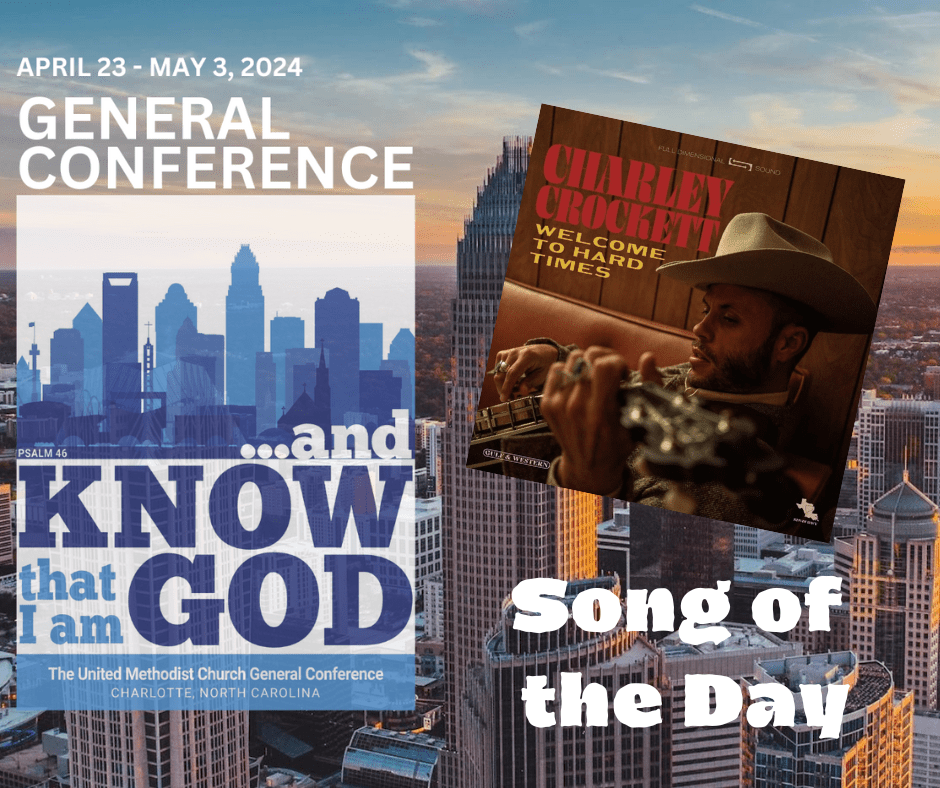
Dr J’s Song of the Day for Day 3 of General Conference is “Welcome to Hard Times” by Charley Crockett.
A lyric selection:
Welcome to hard times and feelin’ low
Do you like sinnin’? No?
Well, you will before you go
We’ve got lots of gamblin’
Oh, and we’re tellin’ lies
You’re certainly welcome to hard times
Take a look in my eyes
Tell me what you see
Besides the bright blinking lights
Stretched out in front of me
I wonder if you’ll notice
Would you even care
If I told you my life just isn’t fair?
Committee work is underway, we’re getting word of delegates that are planning to leave The UMC after serving, and the circular firing squads are setting up to ruin it for everyone involved.
It’s who we are. And we’re good at it.
Let’s see what today brings. -
Q and A with Dr. J #2
I have received more questions and want to answer them here.
1) Will regionalization impact autonomous churches ability to leave denomination?
According to current legislation,(ADCA vol 3 – 1545), conferences that wish to disaffiliate will still have ¶ 572 to become a autonomous Methodist Churches, but the proposed ¶ 576 would also allow them to join with another Wesleyan Denomination (described in the petition).
2) What is the consent calendar?
The consent calendar is a means of passing large portions of non-controversial legislation in bundles. Legislative committees voting to add something to the consent calendar must have less than 10 votes against to add something to the calendar.
The item must not impact the budget or the Constitution. And then it is printed in The DCA, and will be voted on 24 hours after it has been in the hands of the delegates.
Someone wishing to remove an item from the consent calendar must have the signatures of 20 delegates and turn it in the appropriate people. Once the consent calendar for say, April 24th has been reviewed by the delegates, the next day, April 25th, they will vote to approve all items on the consent calendar at once.
.
3) Anything interesting on the April 24th Consent Calendar?
The only thing I find worth noting is the petition (21103-ST-NonDis-G) to create an autonomous Methodist Church in Eurasia. Passing this allows the Central Russia Annual Conference, Eastern Russia and Central Asia Provisional Annual Conference, Northwest Russia and Belarus Provisional Annual Conference, Southern Russia Provisional Annual Conference to become their own autonomous denomination separate from The UMC.
This happens regularly, and they are allowed to do this under ¶ 572. I wish them well. This has been in the works for a while, and it makes sense based on a mix of theological and cultural realities at present.
.
4) Why at General Conference (or others) do we celebrate multiple styles and expressions of praise, worship, and music, yet in our congregations we feel stuck in one mode of worship?
This is a complicated question, but my thought is that we as small communities often appreciate new things at events, but when we return home, people don’t like a lot of change, and the work to change this and do it well takes more energy than most are willing to give.
We are also often trying to replicate something that was done intentionally and beautifully for an event instead of doing the even harder and more important work of asking what worship and formation experiences do our communities actually need? .
We need ongoing conversations about the value of tradition, novelty, and incarnation. These are things that committees can’t do, and these are things you cannot change overnight.
But I encourage you, have the conversations, don’t have the expectations. Let the opportunities grow form conversations -
Social Media Behavior

On my Social Media Presence During the General Conference
1) I work very hard to share information and insight about this General Conference. I take my vocation as educator very seriously and want to educate as best I can. If you see places where I have missed something or could better state something, please let me know.
2) Facebook does not send me a notification of every comment on my posts due to the sheer amount comments I get. if you actually need me, tag me or send me a Direct Mesage.
3) I welcome all perspectives on my wall. I know people who are very conservative and very liberal, and all walks in between. If you engage one another, please do so with respect.
4) I will not tolerate racist, homophobic, sexist, classist, or regionalist or comments on my posts or on my wall, and you will be removed and blocked. I don’t care who you are.
5) If I am too much, please mute me for a couple weeks. I know I am a lot. -
GC News: The DCA

The Daily Christian Advocate is essentially the Daily Newspaper of General Conference (CLICK HERE)
It includes updates from the previous day, agenda for the current day, special announcements, and the consent calendar (a post on how that works coming soon).
I got the paid subscription with extra stuff, and will supplement as necessary.
-
General Conference Recordings
The recordings of General Conference Worship Services and Plenary Sessions are appearing shortly after completion (with time for any processing) on the United Methodist Videos YouTube Page (Click Here).
-
Subscribe
Subscribed
Already have a WordPress.com account? Log in now.
 Jonathan LeMaster-Smith