-
Rural is not the Same as Agricultural

One thing that continues to be an issue in the church responding to rural issues and creating resources for rural communities is the conflating of rural and agricultural. Yes, quite a few people in rural communities are involved in agriculture directly or indirectly. Essentially, unless we are only hunter/gatherers, we are all indirectly involved with agriculture by eating. But, according to the USDA, agriculture only made up 7% of job in non-metro counties (the horrible name they give rural counties).
Dominating rural spaces in terms of employment are government jobs manufacturing, retail, and healthcare/social assistance programs. While this may not include people who farm alongside their full time work ( a very real reality, as agriculture can often not full support a family), agriculture is still not the dominant economic driver overall. Although it likely is in many areas.
Therefore, as we think of rural spaces and how we engage them, we cannot simply reduce them to agriculture. While it may be part of their lives and heritage, overuse of one symbol or archetype or even stereotype, can make people who do not fit into that particular frame of reference or that rural life is crystalized in a time where agriculture was it.
Instead, I recommend a variety of images based on the realities of the community. Even when I teach Jesus as rural figure, I know that he was likely not a farmer, or at least, not as his primary role. He likely worked in construction (as historically we think of him as a carpenter). His disciples worked in government (Matthew), resource extraction (The fishing disciples), community organizing and activism (Simon), and likely other jobs.
And today, many rural folk have no idea how to farm or where their food even comes from. The reality is, rural life is complex, rich, and multifaceted, and we cannot distill it down into a singular images. Instead, we should be collecting stories of rural life, experience, and industry, and work to create the responses and resources needed.
The reality is, my understanding of rural life growing up was farming on the side if you had land and time, and working in manufacturing, schools, or retail.
What has been your rural experience?
-
On Rural Worship: Let People Talk
I’ve been thinking about worship in the rural church lately(since I preach weekly, of course, but also because of a couple projects I’m working on). Worship is one the strangest zones to inhabit. The disagreements over music, sermons, the color of the bulletin, the order of worship, and everything else all flair from time to time. A lot of work and study has gone helping churches craft worship.

However, two things I think are distinctive to rural communities are the announcements and the prayer time, and are often misunderstood in theological education spaces. Not that all churches don’t have those, but that rural churches treat them differently. Often in seminary or other training programs we are taught to keep the focus of the worship on God or the message of the service, or something like that. This leads to pastors trying do away with spoken prayer requests and announcements. They are relegated to the bulletin and prayer request slips handed to the pastor.
But I want to suggest both the times for announcements and vocal prayer requests crucial parts of the rural worship service. Announcements ranging from “Bible Study on Tuesday” to “free cantaloupes on the back Tom’s truck” are important communications. The announcement time at the church is an act of worship. It brings the life of the church and community into the worship space. Whether it’s Girl Scout Cookies, the church down the road’s barbecue fundraiser, or celebrating a 90th birthday, these things matter to the community enough to mention them in worship. This is also a reminder that the worship service serves multiple purposes including community connections.
This is also true for prayer requests. I feel like worship classes keep teaching us to limit people lifting up prayers and stories and testimonies. The reality is, if people have names and situations they want to lift up, let them. If it’s something you think is gossip, ask yourself why is that person sharing it? What’s the deeper concern that they brought it to the body of the church? Let them lift up surgeries, sickness, and needs. Let testimonies happen. If they are happening, that means the Holy Spirit is MOVING IN YOUR CHURCH. People understand that sometimes Mrs. Jones talks too much or that you’re never sure what Mr. Thompson might talk about (made up names, don’t @ me).
‘ve heard of churches where the council/vestry/board meetings happening worship.
Unless there is actual harm happening (and if you’re not sure if it’s harm, ask someone) let the Spirit work.
Moreover, I continue to believe that if we need to cut something from the service for time’s sake, it’s that middle ten minutes of the sermon.
-
My Picks #1 – Charles Wesley Godwin: Seneca

Every five albums I plan to add in a bonus album. These will likely be albums that may never make it on a 100 Greatest Albums list (or at least this kind of list). Still, they are albums that mean something to me and my exploration of faith and music. First up is Charles Wesley Godwin’s debut album, Seneca.
This album means quite a bit to me because it was my first taste of the new wave of independent country artists that are emerging. I was actually looking for Spotify tracks of Charles Wesley (the Methodist hymn writer) to assign in my theology and history courses on Methodism. I didn’t find a lot, but then this guy appeared. I was drawn to his West Virginia Appalachian voice, his songs about mountain rural life, and his way of telling stories – his own and others.
He opened the flood gates for me. From discovering his music, I found Grady Smith – the country music commentator, and he led me to Gabe Lee, Tyler Childers, Orville Peck, and so many others. From there, I also stumbled into Trixie Mattel, Tessy Lou Williams, and so many others. It’s been nearly three years since I discovered Godwin. I missed one concert because of my parents’ health, but was able to catch one Facebook Live Concert. I’ve since seen him concert twice, and am already looking at tickets in February.
He’s released a second album, How the Mighty Fall, since then, but this album was my first. It offers up so many songs about rural life that neither sink totally into despair nor idealism. “(Windmill) Keep on Turning” speaks to the deindustrialization of Appalachia from the late 90’s until now. It talks about the disruption of life since the cabinet factory shut down. That the singer has to sell his craft (making furniture) on the roadside for the half the price just to get by. Even in this struggle, he counts himself lucky, as he didn’t get pulled into the undertow of the opioid and methamphetamine surge that overtook so many of the people in rural and small town America. He ends the song, however, on a hopeful note, reminding us that these “hills are pretty damn nice.” He lifts up the plentiful wildlife, the relationships, and the overall beauty.
The album continues into “Coal Country,” with opening stanza:
I’m going down to Charleston
Through the shadow of the mountain this road winds
Through closed-up towns, forgotten dreams, and welcome signs
Fading far behind
Coal CountryThe song paints the picture of beauty and loss. “Coal Country” reminds the listener of the history of coal in the United States, how it supported so many families and supported the fight against the Nazis. Yet, as coal faded away, it took with it the incomes and identities of so may Appalachian folk. The song suggests that they traded company store tokens for government stamps and addiction.
Now, not all the songs are about rural despair and hauntedness, although we know that’s my main jam. Several are songs of love, relationships growing, and relationships changing. “Sorry for the Wait” is the story of how a man, married young, dies as he’s working in the mines trying to support his wife. It is a song to comfort those who go grieve those lost in the mines or at work in general.
But the two songs that speak to me the most, especially in my most recent listen through, are “Pour it On” and “Here in Eden.” They offer us a couple images of how to endure life in the midst of socio-economic turmoil. The second verse sings…
I try to see the beauty in every bruise
I’ve been huntin’ these peaks and valleys for the spooky muse
It’s a gift unwrapped by all is the weight of time
I can never go back and change this life that’s mineThe singer has chosen to look at life as one of hope, joy, and beauty. While it may be a hard life, it is one that he is going to endure and seize the moments reprieve and soak up every moment of them. He says just pour on the turmoil, because he can handle it because he is full life.
Then there’s “Here in Eden.” A song that points to reality of not just making do on known land and see, but thriving in it. He has the feeling that times may continue to ebb and flow, but he is going to dig himself in where he is and build a life worth living. He encourages those who are worried to make choices, roll up their sleeves, and do what needs to be done.
There’s not enough space here to talk about all the other tracks, but I encourage you to listen.
Ministry Reflections
Now to reflect on the value of this for ministry. I think this album balances the realities of decline with the still present hope and opportunity that can be found, as I often say, just bubbling over the surface. The thing, the hope is not easily recognize amid the pain. “Keep on Turning” urges people to dig into world they live in and find the beauty even if times are hard.
“Coal Country” is the most real in naming the way the rest of the country has treated Appalachia, and it speaks to the reality that the decline in coal without other investment in the region has led to a consistently economically depressed area. It’s a call to remind people that they do get to call out the injustices in their world, even if they are still happy to live where they do and live lives they choose. But beyond these, this album tells us to find find joy in place. It calls on us to build the future we want to see, where we want to build it. It is, perhaps, a call to build our own Eden and find our own joy.
As the church, we can be the educator and partners in rekindling this hope and building a life wherever we choose. It is a life inspired by a divine hope that assures us that a future is possible. This means allowing for a confessing of the realities of life, but helping people to not dwell in it. And instead, helping them to find the hope below it. It also means, helping them to tell their stories so that we can use them as means of cultivating the hope.
Finally, it means acknowledging and holding accountable the governments and corporations that have caused this pain. It means doing so in ways that are not vindictive, but that seek hope for the people there, as they continue to discover ways to allow them to thrive.
As always, I’ll add my favorites to the playlist.
-
Thinking about Heaven
Today (November 8th) is my birthday. And today, an article from Christian Century found me. It is an article about Heaven, and the need for heaven to be real.
I’ll link it here.
And Quote the last two paragraphs:
“Sometimes I wonder if the church’s witness is failing because we don’t know how to translate a theology of heaven for the times we live in. Our culture’s images of heaven are so saccharine, so sentimental, so boring. What would it be like to move beyond clouds, harps, and chubby baby angels? To hold out the possibility of actual peace, reconciliation, and abundance for all?To affirm the truth of heaven is to fire our spiritual imaginations for this life. To remind us of why we endure. To resist the binaries of faith or action, hope or engagement, and to live richly into the paradox that the kingdom of God is both here and coming, both within us and beyond us. To insist that our desire to flourish is a God-given, holy desire rooted in the promise of a life to come.”
I don’t think about heaven a lot. I teach it in my classes, I preach it on occasion, but I don’t dwell on it. But yet, recently I’ve been think about it, and then this article found me.
The need for heaven, not as an escape (which I often worry is the goal) but as the sort of reality that pushes us to live into it now through a mix of spiritual practices and missional advocacy is what I long for. I know that for some heaven is a return to their idealized dream of their heritage, for others, it is a collective peace, and for others it is a space that they got right, but in the end, my hope is that these push people to have an imagination.
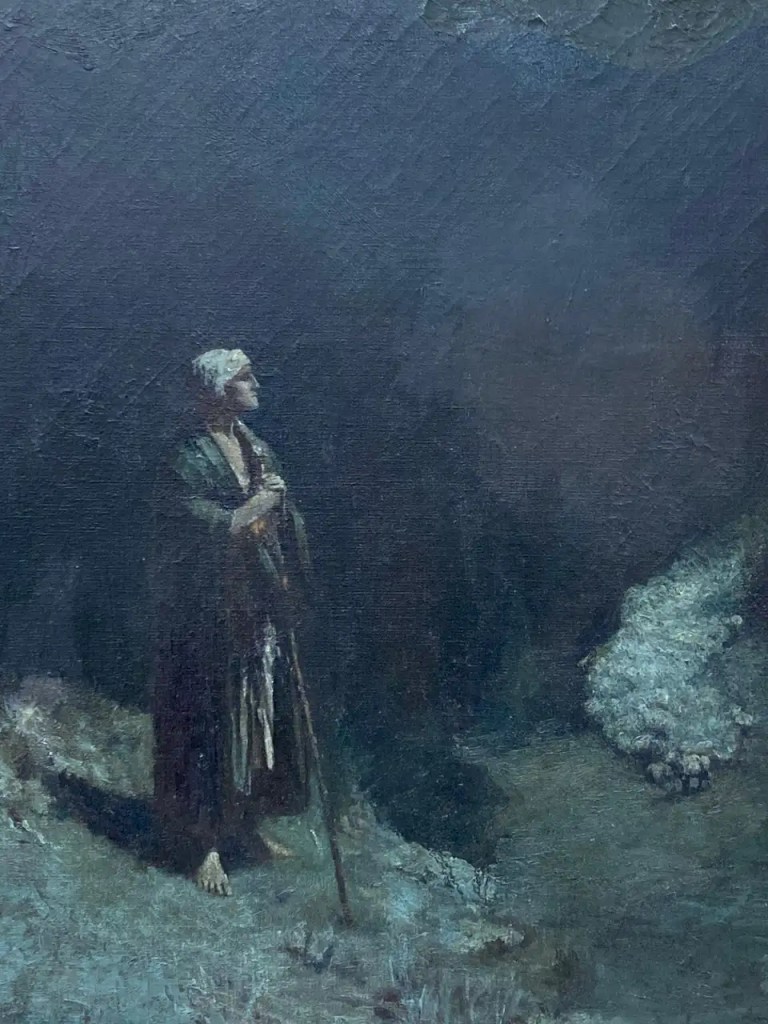
I’m not writing this is a “Heaven is For Real” manifesto, but, and I’ll teach this in my Bible study today, we believe in heaven so we can know why we endure.
I think this is why this painting speaks to me. It is “When I look Unto the Heavens” by an unknown artist who created it around 1920. Admittedly, I found this painting through Googling “Twentieth Century Heaven Art” and seeing what came up. Do you ever do that? Google a thing and art attached to it? It’s beautiful (and a little terrifying).
I don’t know who this person in the painting is, but I was struck by the amount of color in the night sky. It reminds me of the painting of Jesus praying in the garden that seems to hang somewhere in the Methodist churches of my imagination. There seems to be hints of green (at least in my reading of it). A green that reminds us that we can reach out to the heavens, because we are growing toward them.
I also see is someone searching. Someone who knows there is more. They know there is something beyond this present iteration of life and who wants to imagine what that looks like. They want to keep going. They want to live into the heaven they imagine, even as it’s changing.
I think that might be part of my vocation. To help people imagine heaven again, and to build that heaven now. A heaven, that even as we are building it, is changing, growing, and exploring.
I chose to believe, as I learned several years ago, that hope is a learned behavior and a belief that we are not done.
-
96 – Hank Thompson: A Six Pack To Go
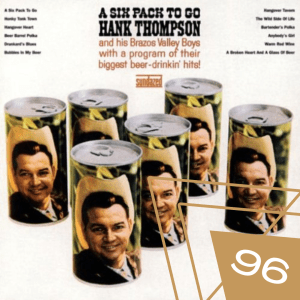
Well. It’s been a while, but I’m back with an album reflection. This time, let’s dive into Hank Thompson’s “A Six Pack To Go.” I don’t fully know why, but this album delights me. Maybe it’s the sort of innocence he brings to drinking, or that it’s an entire album dedicated to drinking, good times, and bars. Regardless, this album has a solid spiritual reality enhanced by the wine, beer, and whiskey.
I think the thing is, we could easily dismiss this as a good times album with a few heartbreak songs and some instrumental polkas, but even in the title track, the line “Tomorrow Mornin’s Sunday/I’m gonna be feelin’ low.” And, I want to think this has less to do with going to church, more to do about thinking about life and the emptiness of Sunday in the fifties, sixties, and seventies due to a mix of culture and blue laws. We see the same thing in “Sunday Mornin’ Coming Down,” and even in contemporary country with Zach Bryan’s “Us Then.”
He’s drinking for multiple reasons. He’s engaging the community, but it seems to be also filling a hole, or searching, and the bar is there. The honkytonk where he goes to find connection, or something like. The song “Hangover Heart” could easily be about the same night. A song about one last kiss, one last drink together, and the the drinks that follow the end of a relationship. This song is likely about a breakup (or even a relationships that never really happened) but it could also easily be about grief from a death and remembering the times they had together.
Really, the album doesn’t stop with great songs. “Bubbles in my beer” is a nostalgia song that portrays a singer as someone paralyzed by their past and viewing all their life as a failure because of one breakup. But, I want to think more about “Drunkard’s Blues.” This song is a that has to be a precursor to the gothic country movement. I have so many questions about this dark song. Did he kill her? Did she kill herself? Did she just leave him and this is a way of him saying he’s over her (or not really)?
Ministry Reflections
For this album, I see some opportunities to think about grief, loss, and the spaces people go to process these losses. Of course, this is can easily be the church, but so often, there are other spaces people inhabit to grieve. This may be the bar, the backyard, or open road, but we need to figure out how to offer the space to grieve in whatever form people do it. We soften prescribe and limit grief to certain realities, but we can’t do that assume we’re helping. To limit grief does a disservice to the living and the dead.
Now, we also need to pay attention to when grief may be becoming toxic and melancholic. People can sink into despair and loneliness, and the church (or the bar) might save them from their losses.
Beyond this, Hank Thompson offers us the reality that drinking and honkytonk living has many purposes. We could easily lay this on why people drink, party, sleep around, etc. That’s not a judgement I want to pass. Instead, I want to suggest, that just as people go to the bar for different reasons, people go to church for different reasons. People come for hope, grief, connection, and isolation. The role of the church is not to create individualized churches for each of these. Bars aren’t themed for grief, sadness, parties, or hookups, they simply exist, and allow for multiple experiences.
If we are going to be a church that lives into a space for people to exist and thrive, we need to consider that we need to figure out who we are (and that may evolve over time), and simply allow people who are drawn to that atmosphere be able to come. My feeling is that good bar isn’t one that is there trying to attract the most people or a particular people, it’s a bar that recognizes its crowd, tries to play the music and have the beer the people like, and let’s people be themselves. The community will come.
The church can easily learn from this. If it can figure out its crowd, the music they like, and the ministries that make sense in their space, the people will come. This isn’t to say the church shouldn’t be prophetic and missional, but first it has to figure out what it needs to be prophetic and missional about.
Playlist:
-
97 – The Flatlanders: More a Legend than a Band

Now we’re getting into new music territory for me. The Flatlanders’ More an Legend than a Band is a weird and sort of mystical album for me. It is full of songs about life, loss, and a mix of hopelessness and hope that both teeter on the edge. I’d never heard of this group, but they now fill my ears with a musical saw (I had to look up what that sound was) that haunts me and imagery about places and people that need exploring.
The three songs that speak to me most are “Dallas,” “She Had Everything,” and “Keeper of the Mountain.” “Dallas” is a place song, and I will sink into a place song. It’s not a flattering song about Dallas, but it makes you want to go there. Dallas as a woman that will walk on you when you’re down or a rich man with a death wish and a loving disguise? It makes you want to go there to see what it’s like. But at the same time, we’ve all experienced those places you go into with hope and you fall into despair.
“She Had Everything” feels like a song about someone who is dealing with loss from a woman he gave everything too, and she just wasn’t happy. The need for constant accumulation or simple discontent wears on our lives. Or, perhaps it has to do with how the wealthy (or just entitled people in general) act as if people are disposable. I will say, early Taylor Swift felt this way to me. What I learned from her releasing her “Taylor’s Versions” of things, is that it was less her mode and more her record label that was creating the consumer of people mode.
Finally, “Keeper of the Mountain” feels like a song about discovering the peace of life and the beauty of creation beyond our own projections and experiences. Or, that our experience of nature is just us working through our emotions and spirituality.
In terms of ministry, “Dallas,” with its personification of place reminds us that people can feel beat down, abused, and mistreated by a space just as much as it can be lifegiving. I know many people who feel the church has harmed them and their community. Also, it’s a reminder of the value of place and the experience of place. So often we over emphasize that the church “is a people” that we forget that place matters as much as people, particularly in rural spaces. These spaces are haunted with our experiences, memories, and histories.
“She Had Everything” is a reminder to offer the corrective to the abusive consumer mindset of life. This is particularly important as we live in a world that leans increasingly more consumeristic, even in the church. It’s a reminder to the church as well, to not consume people. The church has a bad habit of using people for their resources, skills, and time without offering the nurture and sanctification it promises.
Finally, “Keeper of the Mountain” is the most hopeful for me. It helps me think of how to teach and preach connection to nature and place in general. To think of a space moaning (all creation moans), or grieving, or rejoicing, is the reminder that we are part of creation and we are part of it. Whether it’s the natural world or the cultural places we call home. It is a reminder to experience how connected we are to place.
Honestly, this was a hard one to write, even though it was a tremendous album. I recommend the whole album, but check out the playlist for the three I mention here!
-
Persimmon Pudding Recipe – Podcast Episode 4
In Episode 4, Rev. Karen Kleuver talks about Persimmon Pudding, and here’s the recipe!
Persimmon Pulp: https://simplejoyfulfood.com/want-to-learn-how-to-make-wild-persimmon-pulp/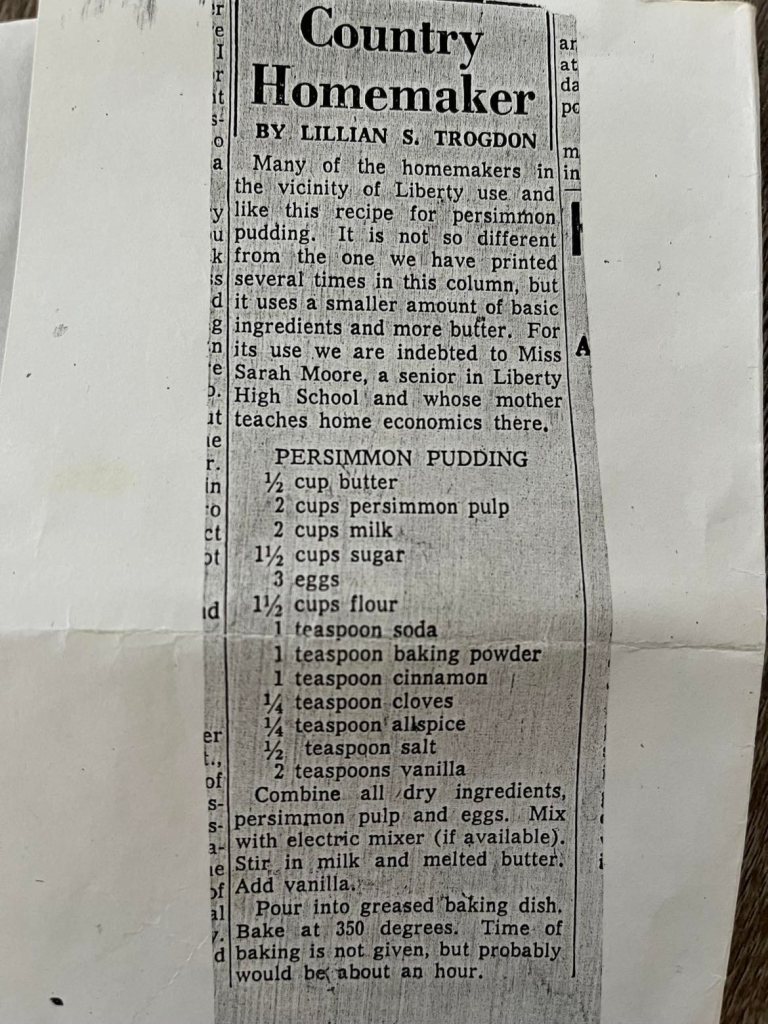
-
98 – Keith Urban: Golden Road

I have to admit, I’m not a big Keith Urban fan. I’ll listen to his songs on the radio, but I don’t search out his music when given the chance. I enjoy him for what he is, pop country, somewhat innovative, and a non-US country singer. But, since he was on the list, I wanted to give him a critical look.
This album is a mixed bag for me. I understand why it went triple platinum, won awards, and shot up the charts. It’s a fun album with some thoughtful pieces on it. In terms of the singles, they are solidly selected from the lineup of songs in order to draw people in to an album. The lead single “Somebody Like You” is a fun single that pulls you into a poppy early 2000s state of mind. But, on the album, “Whenever I Run” is the same song, but better.
“Whenever I Run” (not to be confused with Lady A
ntebellum‘s “I Run to You,” like I did for several minutes) is more somber pop country song that instead of being a “boyfriend country” song, serves as the “companion song.” Based on my previous two reflections, I know the companion song is a powerful country song that pushes past romance into resilience through connection and relationships. Whether it’s with a woman, a significant other, a place, or a community, it offers a space to find hope and endure whatever life might throw.The other two of my favorite songs “You’ll Think of Me” and “Raining on Sunday,” were released as singles. “You’ll think of Me” is a breakup song that leans into territory of “you’ll miss me more” territory that is really a defense mechanism for someone grieving the loss of a relationship. It has some strained lyrics, but overall, a good breakup song. “Raining on Sunday” is the “rediscovering each other” song. Sure, it might be a sex song, but what isn’t? Regardless, this song feels like a mix of “live into the interruptions” and “refocus on what matters.” I think the sabbath language in it might be the best “Sunday” song out there (besides “Sunday Morning Coming Down, of course”).
Now, for the ministry and spiritual reflections, let’s work backwards.
The album is titled Golden Road and I think it lends itself to asking the question of what roads we travel, where they lead, and why we are driving in the first place. “Raining on Sunday” tells us to take time to reconnect, breathe, and disrupt any schedule that has us driving constantly toward someone else’s goal. Obviously its religio-spiritual imagery is there, “a cross in Mexico” and “a prayer nailed to a door,” waiting for heavy handed interpretation. The song is literally a baptism for new life and new direction.
However, the sabbath and Sunday interpretation is better when it rips productivity and expectation out of the hands of the clock and the bank. I think, particularly of the feeling expectations as a church worker (or church member) because many churches and faith communities are as production minded as businesses. Take the day off, spend time reconnecting with yourself, your loved ones, your place, and the Divine. Sunday, if anything should disrupt the rest of our lives, and cause us to run off the main road into new spaces.
From a ministry perspective, offer permission and possibility to take time disconnected from the world.
“You’ll think of me” is a breakup song, but also a song of grief, of separation, and a reminder that grief, heartbreak, and loss is not solved in afternoon. Mourning is an ongoing process, and sometimes you process through crying, sometimes through cleansing your space, and sometimes, you go on a long drive.
Finally, “Whenever I Run” is ripe for a “Jesus is my lover” shakedown. Let’s not. Instead, this is a reminder to have the people, places, and communities that are our companions that we can turn to. Sure, Jesus could be there too, but that feels boring to me. Instead, from a ministry perspective, use the language of companionship, community, and connection to help folks be reminded that they have or can create spaces to run to for help, support, and endurance. And, as Lori McKenna’s “This Town is a Woman” song reminds us, it may actually be the backroads that we run to, because they know us more than we know ourselves.
As always, here is the playlist:
-
99 – Kitty Wells: Country Hit Parade

Kitty Wells: Country Hit Parade To go from early 2000s beach country to an absolute legend with Kitty Wells’ legendary Country Hit Parade is, at first, a little jarring. The classic sounds of steel and twang are much more present in her iconic songs. Yet, the reality is, Chesney is in the same lineage, and you can see it in songs like “The Good Stuff” and “A lot of things Different.”
But we’re here to talk about Kitty Wells. To be honest, I knew who she was, I had heard “It wasn’t God Who made Honky Tonk Angels” and “Heartbreak USA,” but I hadn’t thought much about them. Then, I listened to the whole of this album (I actually listen to each album several times) and I was amazed. The emotion, matter-of-factness, and power in her sound moved me.
I think the best songs on the album are “Release Me,” “There’s Poison In Your Heart” and “The Things I Might have Been.” These songs, all about relationships, all take three very different directions. “Release Me” is a woman who want to get out of a relationship. Whether she loved him or not, whether she’s married to him or not, she wants out. At first, I thought it was a defiant, here’s what I’m doing in a polite way, but as a conversation with a friend led me to see it as a desperation. She is longing to leave a relationship that she does not love. Either way, she names it a sin to stay in a relationship that there is not love, even if that’s what you were supposed to do. And in the 50s, for a woman to publicly name her desire to leave a relationship is a powerful statement.
Then, “There’s Poison in Your Heart” sings of a man who is a smooth talker who claims to love this her enough to “change her name” but she knows. She knows who he is, where he’s been, and what the outcome will be if she falls for his charms. This song is a call to pay attention to the actions of folks and find out if they are not truly faithful and honest people.
Finally, “The Things I Might have Been” is my favorite song on the album. This song is a song of thanks and devotion to the person that made her who she is. She’s thinking about how things might have been and naming her joy that she found someone who makes her happy and the person she is today. Of note, she doesn’t name better offers, only the potential dead end lives she could have lived. And perhaps this might be a coping mechanism, but with all the other sad lyrics on this album, a love song is welcome.
From a faith and ministry standpoint, these songs offer us some things to look at.
“Release Me” offers the reminder that while, as some of her other songs names the realities of infidelity (“Cheatin’s A Sin” and “Backstreet Affair”) this song reminds people that staying in an unhappy marriage can lead to sin as well. It is better to end a marriage than drift into toxic relationship status. Now, I’m not saying don’t work on your relationship, but I’m also saying, don’t stay just because society tells you to. As people who lead in congregations, engage with people, we need to be mindful of how we speak about relationships and realities.
“There’s Poison In Your Heart” of course is about, at face value, dishonest smooth talkers. But, why not look at it from the perspective of “false prophets” or, as the parable in Luke suggests, “The Wicked Stewards.” That is, people who will use charm and even the faith to get what they want, even if it’s not helpful. In the song, this man is likely wanting a good time, not a long term relationship, as he has continually caused grief for the singer. And, as we see in life, there are people who will say one thing to get to another. Particularly in ministry, we need to make sure there is not poison (or ulterior motives) in our language of faith, hope and love.
Finally, “The Things I Might Have Been” could easily be a salvation love song. But in the end, I think that’s the lazy answer. Instead, let’s think of it in terms of the church asking questions about it’s present and past. Churches often dwell on the lost futures they might have had (or he pasts that they wished had frozen in place), but they don’t think about the realities of what might have been. They might have closed up due to budget issues. They might have been so inward focused the failed to do any missions. They might have been so apathetic to ministry, that they just bored themselves to death. Therefore, when we get the “we used to’s” and “if only’s” we need to respond with the reminder that there are many other futures they don’t name.
Let me know what you think.
As with think about the practicality of it all, I name some of it above, but most of all, remind people to be be aware of the reality of life, not the perceptions or expectations. Whether it’s proper to stay in a relationship even when it’s not working (whether in life or the life of the church), to pay attention to the motives (or our motives) when we use language and action, and finally, to remind ourselves that while the world is not ideal, there are not just rosy alternatives.
As always, here’s a link to the play list with these three songs plus all the others.

Also, if you like country music reflections, consider listening to my podcast on rural life, I start each episode off with a song reflection (and in fact, “Release Me” will show up in one of the first 5 episodes).
-
100 – Kenny Chesney: No Shoes, No Shirts, No Problems

Album 100: Kenny Chesney “No Shoes, No Shirt, No Problems” For some reason, I didn’t expect Kenny Chesney to be on this list. I don’t know why. I enjoy his music, I think he has his finger on the pulse of a certain kind of country fan. He’s not bro country, nor is he beach country. He feels a lot like John Denver’s Windsong album. It’s about country people who moved to the city or drive hybrids. It’s not a bad thing, but it feels that way.
Also, this unlocked some high school feelings because this album came out while I was in high school. As the Rolling Stone article reminds, Chesney is good at nostalgia and tearjerkers. He is also good at talking about the joy of success. Whether it is a life well lived (The Good Stuff), the joy of relaxation (No Shoes..), or the fame and fortune (Big Star).
From a rural theologian’s perspective, this album offers opportunities. Chesney, while nostalgic, isn’t longing for a golden return with this album. He’s being real about the things he would do differently (A lot of Things Different) and that you can’t go back, but you have your memories to give you hope in the new part of life (Never Gonna Feel Like that Again).
His songs remind us that our memories, our music, and our heritage give us strength if we let them. We can be pulled backward by our anxieties, wishes for a past, or a lost future, or we can trust God enough to read the scriptures, our histories, and our lives with a hope that we can move forward. Chesney reminds us, in a very Ecclesiastes way, to enjoy life, remember the past, and to seek out what matters.
From a practical perspective:
“Big Star” reminds us to work hard, know our passion, and be true to ourselves. It’s not a faith-oriented song, and yet, it points us toward a trust that we have a future that waits for us. In our lives, what are the futures we think we (as individuals and communities) might be called to, and what are we willing to do, give up, and overcome to get there? Many people and churches need a push to start that journey.
“Never Gonna Feel Like that Again” and “A lot of Things Different” are the reminders that our memories are valuable, but they are not our future. We can use them to give us the strength to live into whatever comes next but, we cannot let them overcome us. When we think of memories and heritage, what are the memories that give us strength? What are the memories that might hold us back? How can we use them to build the future?
Finally, the title track “No Shoes, No Shirt, No Problem” is a sabbath song if there ever was one. However, it could easily become a flaky “take a nap” song if it didn’t pair so well with the rest of the album. It is the most, “nothing matters” songs, but, when paired with the whole album, brings into focus what matters. The lyrics, “no boss, no clocks, no stress, no dress code” point out the things that burden us, and point us take time to enjoy what matters.
Now, of course our faith, family, and community matter. What I see coming from a spiritual and practical approach, is taking time to breath, rest, and talk about the memories and the opportunities that await. Likely not a sermon, but a more like a cookout, bonfire, or other space of rest and disruption. Talk about the memories, the hopes, and what we can do to live into the beauty that the future holds.
Let me know your thoughts!
Here’s a playlist of my three favorite songs from each album I’ve posted on so far:

Also, Like Country Music? Consider my class “Country Music and Christian Faith” at BeADisciple.com
Vivid in imagery, story, and emotion, the world of country music is a space where many turn to grieve, celebrate, endure, and even pray. “Country Music and the Christian Faith” is for learners who want to connect their love of music and their spiritual lives. This three-week course explores the connections between music, faith, and community without leaving behind the edgier parts of the country genre.
Much of the course consists of listening to and reflecting on music that reflects the history and diversity of country music, creating space for shaping spiritual practices and meaningful playlists. Optional gathering times will be provided for listening and reflecting. The resource library will be a mix of articles, videos, and podcasts on the history, theology, and spirituality of country music from Alan Jackson to Zac Brown.
-
Subscribe
Subscribed
Already have a WordPress.com account? Log in now.
 Jonathan LeMaster-Smith